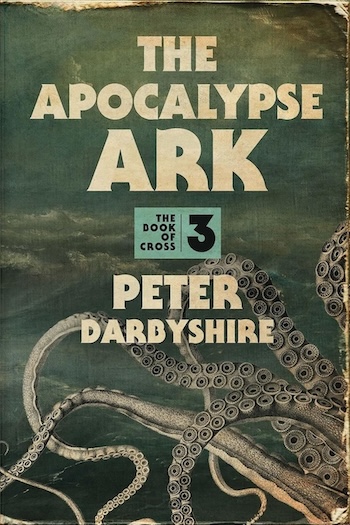
 The Apocalypse Ark is the third novel in Peter Darbyshire‘s Book of Cross series, and today we have an excerpt from the book. We’ve already shared excerpts from the first two books in the series — The Mona Lisa Sacrifice and The Dead Hamlets. The three novels are out now, published by Poplar Press. Here’s the synopsis for the third book:
“You fool,” Sariel said. She gestured with a hand and the table between us slid to the side. “You ridiculous mortal fool. What did you do with the sphinx?”
With these words Cross finds himself thrust into his most dangerous adventure yet, working with the double-crossing angel Sariel to stop Noah from ending his eternal suffering by ending the world. But this Noah has not saved any beings from the flood, he is God’s warden, and he is bound to hold all God’s mistakes captive on his ark for eternity. And he has gone mad. Between provoking the sorcerous pirate Blackbeard, dealing with the devious vampire Ishmael and travelling beneath the seas with Captain Nemo and the last of the Atlanteans, Cross struggles to keep one step ahead of Noah until the last battle occurs before the very doors of Atlantis itself.
*
IN THE BEGINNING WAS THE BOOK
The end of the world began with a bible. It’s always the bibles that cause problems.
I was walking the dusty trails of the Camino de Santiago, an ancient route for pilgrims that crosses Spain. Other travellers shared the path with me, and some of them tried to engage me in conversation from time to time. I ignored them all. In my head, I walked alone. I was trying to escape the memories of the past, and I didn’t want to add any new ones.
But sometimes the past won’t let you escape.
I made my way along a stretch of trail that wound through the hills beside the sea, which was churning with dark clouds in the distance as the day’s light began to fade. A few raindrops began to fall on me, so I cast about for shelter. There was only a weathered graveyard in the distance, nestled up against the slope of one of the hills. Something about it looked familiar, although I couldn’t exactly place why. I didn’t have time to think about it, though, for just then the world lit up with the flash of lightning, and the thunder was like some ancient seal of Heaven being broken.
I turned back to the storm, hoping I was simply dreaming on my feet. But what I saw was something out of my nightmares.
The storm clouds were rolling across the sea toward me, and lightning flashed in them again. Only some of the lightning reached out from the clouds and struck at the heavens overhead, while other bolts probed the sea’s depths, as if searching for something. I caught a glimpse of shapes moving in the clouds, the silhouette of a great ship. I looked about for other pilgrims on the trail, to see if they were witnessing the same thing, but there was no one. It was just me and the storm. And that ship. If it was the same ship I thought it was . . .
I turned and ran for the hills.
The rain came down on me hard by the time I reached the graveyard. I paused in the middle of the worn, leaning crosses and other grave markers, scanning the names on them. Maybe the place felt familiar to me because of somebody I’d killed in the past who had been laid to rest here. Or maybe one of these dead had killed me in one of my own past lives. But I didn’t recognize any of the names.
Then I saw it.
A big slab of rock in the hillside that had a faded cross scratched into its surface. A cross I’d made centuries earlier, when I’d pushed the rock there. I went over to the rock and shovelled away the dirt on one side with my hands, until I’d made a gap between the rock and the hillside. I wiggled into the gap and tried to push the rock out with my shoulders. Nothing. It was a big rock, after all. I used a bit of heavenly grace from Mesion, the angel I’d recently hunted down and killed in the sewers of Prague, to give me strength and tried again. This time I managed to push the rock out a bit, widening the gap and exposing the cave behind it. I slid through, leaving the rain behind. I didn’t want to linger, though, not this close to the storm. So I went deeper into the cave, breathing the musty air. It was probably the same air I’d breathed the last time I was here. I hoped it was the only thing about this visit that was the same. I grabbed a torch from a sconce on the wall and set it ablaze with a lighter from my backpack. Let there be light.
The monks that had once lived here had built upon the natural cave system in the mountain, carving larger chambers out of the rock and shoring up the ceilings and walls with wooden beams to create their hidden monastery. They’d made it as homey as they could, decorating the place with worn rugs and even a few tapestries on the walls depicting the coming return of their saviour. I’d made a mess of that when I’d arrived here the first time.
I went into the dining hall and found it much as I’d left it. The ceiling was largely fallen in, and there was a gaping chasm in the floor that dropped away to who knew where. The tables were overturned, and dishes and cutlery were scattered everywhere. These were the remains of the battle I’d fought with the angel Sariel so long ago. I hadn’t exactly come out victorious in that one, but you can’t win them all. Especially when angels are involved. I went around the edge of the chasm and continued on, looking for someplace to hide or maybe another way out on the other side of the hill, far from the sea.
I had to use more grace to clear away great piles of stone throughout the monastery. Sariel had sealed off the different halls from one another when she’d brought down the ceiling. I noted scratch marks on some of the rocks I moved. Someone had been trapped here and tried to dig their way out. But there would’ve been no moving those stones without grace. Sariel and I had been the only ones with grace in the monastery back then. And look what we’d done with it.
I found the bodies of a half-dozen monks in the scriptorium, scattered among the remains of the books they’d been illustrating. Most of them were on the floor – leathery, mummified figures in mouldy, dark robes surrounded by piles of yellowed tomes. One of them was still sitting at his worktable, though, slumped over a text he must have been trying to finish before he died. He had a quill clutched in his skeletal hand, and I eyed that for a moment. I’d had some bad experiences with magic quills. But I could see the inkpot on the table was dry, and this quill was just a regular writing instrument.
The monks must have come here when they’d realized they couldn’t find their way out through the fallen rock. Had they simply wanted to die surrounded by the texts they loved? Or had they wanted to finish what they’d started? Only the dead knew, and I didn’t feel like raising them to find out the answer.
I almost envied them their fate. If you had to die forever, spending your last moments in a room full of books wasn’t a bad way to go.
The chasm had split the floor in here, too, although it tapered off halfway through the room. I wondered if any of the monks had thrown themselves into it at the end. I didn’t yet hear the sounds of the storm entering the monastery to seek me out, so I set the torch into a sconce on the wall and decided to pass some time with the books on the floor. I blew dust from their covers and opened them, carefully flipping the brittle pages. They were mostly books of hours and devotional texts, collections of prayers and psalms the monks had illustrated for wealthy patrons. There were a few others of the sort you would usually find in buried, forgotten monasteries: inspirational tales of noble pilgrims resisting wine, women and wyrms; a copy of the Lost Testaments; a guide to weaving with drawings of naked, lewd women hidden away in its pages. None of them were books of any power or even import, though.
I sat at the table beside the dead monk. There were other tools of the monk’s trade near his hands – some brushes; jars of dried, crumbling paint; even a little pot of gold flakes to be applied to the important illustrations in the book he’d been trying to finish. I pushed them aside to make room for my backpack and took out my last bottle of wine. I opened it and drank straight from the bottle. I offered the monk a drink, but he didn’t seem interested. I pushed him to the side a bit so I could see the book he’d been trying to finish.
It was a leather-bound tome with yellowed, crumbling pages. The monk had been working on a full-page colour illustration when he’d died. An illustration of an angel leaping upon a white whale breaching the water, a harpoon blazing with green fire in the angel’s hands.
I nearly spat out my wine when I saw the illustration, for I recognized the angel. In fact, I recognized everything about the picture. I’d been there when it had happened in real life after all.
I closed the book to look at its cover. The title had been roughly carved into the leather with some sort of blade, the words then filled with a mix of what looked like gold flakes from the monk’s pot and blood that had long since dried.
Moby-Dick by Herman Melville.
It was a book that never should have been in this monastery, since it wasn’t written until centuries after I’d sealed this place off from the world. Unless someone else had been here to leave me a message.
*
Peter Darbyshire’s The Apocalypse Ark is out now, published by Poplar Press.
 Civilian Reader