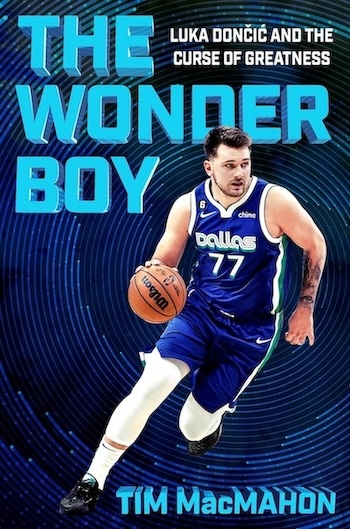
 ESPN’s Tim MacMahon chronicles the career of the Dallas Mavericks’ Luka Doncic and examines the pressure of building an NBA team around a prodigy.
In 2018, the Dallas Mavericks landed the most hyped European teen prospect in basketball history—Luka Doncic, who has proven to be a generational NBA talent with a flair for sensational playmaking. But that’s only half the story. With The Wonder Boy, MacMahon takes us beyond the highlights to the madness that ensues as the Mavericks try to avoid blowing their golden opportunity.
From the internal power struggles in owner Mark Cuban’s front office during the early years of Doncic’s career, to the new regime’s effort to earn Doncic’s loyalty and put the ruthless competitor in position to win, readers will learn never-before-reported details about the saga’s biggest moments, including:
-
- the blockbuster deal for Kristaps Porzingis that blew up in the Mavs’ faces
- the divorces with coach Rick Carlisle and GM Donnie Nelson
- Jalen Brunson’s exit after a run to the Western Conference finals
- the new pairing with the mercurial Kyrie Irving
- the improbable journey to the 2024 Finals
As the clock ticks on the Mavs’ quest to win it all with their irreplaceable young star, The Wonder Boy pulls back the curtain on a dilemma every NBA team would love to have.
Anyone who has watched the Mavericks play since they acquired Luka Dončić in 2018 will recognize the player’s electric talent. Blistering stat-lines define most of his NBA career so far. He is not, however, otherwise particularly well-known. Like many non-American stars, he remains quite private and not the most forthcoming when it comes to the media/press. In The Wonder Boy, Tim MacMahon attempts to explain this young phenom, and how he fits into the modern NBA.
The impression of Dončić that I gained from reading the book was a mixed one. The many stats MacMahon includes (including comparators, of course, to highlight his historic production) certainly paint a picture of spectacular talent. It is also a portrait of a volatile young man who has some maturing still to do. (I’ll come back to this in a moment.) The book is also the story of the Dallas Mavericks, and portrays them as a bit of a chaotic organization. MacMahon gets some great quotes from a variety of people in and formerly of the organization. Some of them clearly have axes to grind (even if just small ones), but some of the best parts of The Wonder Boy have nothing to do with Luka. There were many interesting characters working for or with the team, and MacMahon does a great job of weaving their thoughts and observations into his narrative. In this way, it seems like the arrival of Dončić was a handy hook on which to hang a book about the Mavs in general. Mark Cuban, former owner yet still head of basketball, gets a lot of ink, but it’s not always good.
“Mark’s like a toddler,” Voulgaris said, “so if you leave him unattended for a few minutes, you don’t know what’s going to happen.” (p.94)
Personally, I found the portions about Jalen Brunson to be much more interesting — he’s now a star for the New York Knicks, but it was clear that the Mavericks execs, while keen on him (drafted with the 33rd pick in 2018), never saw him taking the leap that he ultimately did. I came away from this book thinking that Brunson might have been a more interesting subject for a book (or, certainly, a long profile). Who doesn’t love stories about people exceeding expectations?
That being said, people not meeting expectations is also a compelling storyline, so there’s a little bit of that when it comes to Luka — especially given his incredible success and dominance pre-NBA. It wasn’t until last year that the team managed a deep run into the post-season, reaching the finals, but Dončić experienced success at the highest levels in Europe. (Which leads me to, again, admit that I was wrong about the Mavs picking up Kyrie Irving — he has undoubtedly been an effective addition to the team.)
The chapters covering Dončić’s European basketball career contained the most new information for me, and really helped explain why he was such a sought-after prospect when he declared for the NBA draft. From a very young age, Dončić just dominated. This portion of the book also does a very good job of establishing Luka’s character — which, as I elude to above, isn’t as mature as one might hope from a franchise player. The Wonder Boy is littered with almost as many instances of immaturity and petulance as it is historic stat-lines — from complaining to the refs (which he does almost as much as he plays basketball), to visibly beefing with his coach, to meting out “revenge” on players he believes to have disrespected him. His outbursts have become par-for-the-course. For example, during the 2021 playoff series against the LA Clippers, during a difficult stretch Luka was seen shouting in then-coach Rick Carlisle’s direction. “Nobody on the Mavs’ bench blinked. Dončić’s blowup was business as usual.” (p.145) In this respect, Dončić is a classic diva superstar.
But we then have to come back to his basketball production, which is incredible and often leaves other superstars in awe. Like his fellow Balkan superstar, Denver’s Nikola Jokić, Luka’s stats are often superhuman — although, Dončić’s play is more “obviously” flashy and impressive. After reading about his first couple of years in the League, it’s very clear why Dončić is given so much space and freedom to direct play on the court. MacMahon includes a fair number chapters that recount impressive games (a couple too many for my taste, as I don’t generally find them interesting to read) that highlight Luka’s obvious talent. It will certainly be interesting to see how he and his team fares in the future, as he will no doubt continue to get better and (hopefully) mature as a player — not just in terms of his temperament, but also his conditioning; too often what’s holding him back is nagging injuries.
MacMahon’s skills as a journalist are clearly on display, and there’s a lot of great, engaging and well-written content in the book. The book suffers from the lack of input from and access to the subject, but that is always the case when it’s not a memoir or official/authorized biography. Perhaps if we were further into Dončić’s career there would have been more material to work with. I couldn’t help but compare this to Mike Singer’s Why So Serious?, a biography of Jokić. The Denver Nuggets star is also media-/press-shy, but also has a very different temperament. Unlike Dončić, though, he’s also a 3x MVP, champion, and Finals MVP, which provides a lot more to write about than game reports. The books are also similar in their reliance on others to inform the reader about their subjects — and both authors do a great job with the access that they have.
The Wonder Boy is, of course, a must-read for Mavs fans, and anyone who has a more-general interest in understanding how a team works and manages a star (with an ego). Recommended.
*
Tim MacMahon’s The Wonder Boy is due to be published by Grand Central Publishing in North America, on March 25th.
Follow the Author: Website, Goodreads, Instagram, BlueSky
Review copy received from publisher
 Civilian Reader