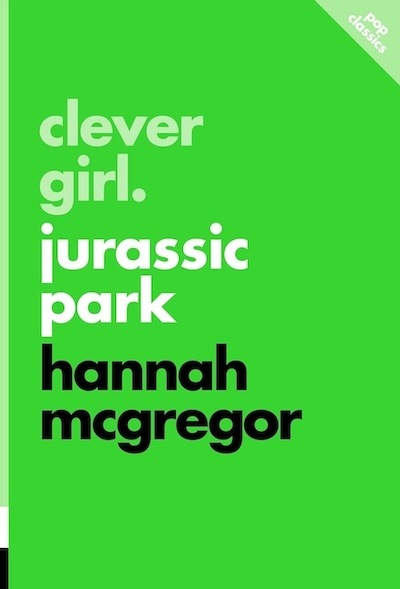
 Next month, ECW Press is due to publish the next book in their Pop Classics series, which is a range of “Short books that pack a big punch… intelligent, fun, and accessible arguments about why a particular pop phenomenon matters.” (Looking at the range, I have a feeling I’m going to be reading a few of these.) Hannah McGregor‘s Clever Girl focuses on Jurassic Park — a movie that I saw in theatres when I was only 10yrs old, and a franchise that I’ve followed pretty much ever since. To celebrate the upcoming release, the publisher has provided CR with an excerpt to share with you all. First, though, here’s the synopsis:
A smart and incisive exploration of everyone’s favorite dinosaur movie and the female dinosaurs who embody what it means to be angry, monstrous, and free
The Jurassic Park series is one of the most famous and profitable movie franchises of all time — an entire generation of people has never known life without these CGI dinosaurs. The movie spectacle broke film and merchandising records, pioneered special effects, and made Jeff Goldblum into an unlikely sex symbol, and now it has also been re-envisioned as a classic of queer feminist storytelling.
In Clever Girl, Hannah McGregor argues that the female-only dinosaurs of Jurassic Park are stand-ins for monstrous women, engineered by men to be intelligent, violent, and adaptive, and whose chaos resists the systems designed to control them. As they run wild through their prison, a profit-driven theme park, they destroy the men and structures who mistakenly believed in their own colonialist and capitalist power, showing the audience what it means to be angry, monstrous, and free. The velociraptors were not just jump scares for children but also revelatory and predatory symbols of feminist rage. Clever girls, indeed.
*
Introduction
“Objects in mirror are closer than they appear”: On Looking at Dinosaurs and Dinosaurs Looking Back
The first glimpse of a dinosaur we see in Steven Spielberg’s 1993 blockbuster Jurassic Park is just an eye, glaring through the bars of a cage, coldly intelligent and filled with an other-worldly hunger. We don’t see another dinosaur for almost 20 minutes, but that eye haunts the rest of the film. It hovers in our thoughts, watching us as we watch the dinosaurs, reminding us that they are not only props nor exhibits but something else altogether, something simultaneously sentient and caged and furious.
I was nine years old when I first saw Jurassic Park in a theater, and even by that age, my obsession with dinosaurs was well underway. There was plenty fueling that flame — a seemingly endless and capitalistic supply of dinosaur toys and children’s books — but the initial spark was the fossil gallery at the Canadian Museum of Nature. Amongst the dusty dioramas of Ontario wetlands and cases and cases of rocks and minerals, the dinosaur fossils were a shock to my childhood senses. I had seen real-life birds and rocks before; dinosaurs belonged to another world altogether. Part of my awe was at their sheer enormity, their fossilized skeletons looming over me despite my size; I was always big for my age, broad and sturdy and tall, graceless next to other girls. But the Museum of Nature didn’t just stick a skeleton in a room with a plaque — they went all-in on evoking the strangeness of the world dinosaurs lived in, decorating the displays with enormous ferns and piping in an imagined soundscape of ancient jungle noises.
Staring up at those fossils, I was transported to a world so different from my own that I swear I could feel myself disappear; something in my chest cracked open and let the infinite in. A couple of years later, sitting in a darkened theater, feeling the thump-thump-thump of the T. rex’s footsteps vibrate in my chest, I felt that sensation again. If I’d known this word back then, I would have called my encounters with dinosaurs “sublime.” Their vastness made me feel small, not in the ways that, as a girl, I was already accustomed to feeling small — sneered at by the cool kids, picked last for every team — but in the way the ocean or a really tall mountain can shock me with a sudden awareness of my own insignificance. In the face of the sublime, I become at once nothing and everything, part of the majestic and meaningless stuff of creation.
Neither oceans nor mountains were in my aesthetic vocabulary at the time; the landscape of Eastern Ontario was less sublime vistas and more of the aforementioned rocks and birds. I grew up in a tiny postwar house on a one-block dead-end street in the decidedly provincial town that was Ottawa in the late ’80s and early ’90s. I was one of two children in a straight white Protestant household, surrounded by other children being raised in other straight, white, Protestant households. My world was small, though I mostly didn’t realize that because it was all I knew. Summer vacations were cabins or camping or some combination of the two, surrounded by other white families that looked a whole lot like mine. We visited lakes usually — never one of the imposing Great Lakes with their oceanic tides and ship-swallowing storms, mind you, but one of the thousands of small lakes that dot Eastern Ontario, sludgy little bodies of water bordered by cattails and populated by snapping turtles and schools of tiny brown and silver fish flickering in the shadows, lakes you wanted to avoid the edges of because the murky bottoms threatened leeches. Better to canoe out to where it was deeper and jump in from there. These spaces didn’t feel any wilder, to me, than my own backyard, thick with ferns and hostas, echinacea and bee balm, sage and mint and two kinds of parsley.
If you grew up in a big city, this might sound quite adventurous to you. But like all aesthetic categories, the sublime is a matter of perspective, a function of familiarity and personal experience.
Our imaginations, writes nature writer Verlyn Klinkenborg in his article “What Were Dinosaurs For?,” “tend to normalize the strangeness of nature, and . . . one of the immense virtues of science is its unceasing ability to defamiliarize what we thought we knew.” Encountered first in museums and later in classrooms, dinosaurs were a shock to my system, hinting at a world so much larger than what I had seen. They tugged at my imagination with the promise of something more — more chaotic, more unruly, even, dare I say, more queer.
THE MONSTROUS GAYS GAZE
Why do we love looking at dinosaurs?
Jurassic Park is a film about looking, but as feminist film scholar Laura Mulvey has argued, so are most films. Within the visual language of cinema, the camera operates like an eye through which we, as viewers, might enjoy our scopophilia — literally the pleasure of looking — without being ourselves subject to the gaze. And as Mulvey explains, that cinematic gaze has traditionally been a deeply gendered one, enacting a masculine pleasure in looking at objectified women. We can slot Jurassic Park into this same tradition: it’s a film about the pleasure of looking at dinosaurs, and those dinosaurs are (not coincidentally) all female, and all being actively objectified as professional showman John Hammond and his team of scientists attempt to turn them into spectacles.
 Jurassic Park was a technological and cinematic breakthrough, winning the 1994 Academy Award for Best Visual Effects. It also marked the apex of a long history of people vying to secure the rights to display dinosaur remains. Fossil-hunter Barnum Brown, who discovered the first T. rex remains in the early 20th century, was funded by the American Museum of Natural History: he was looking for fossils specifically to put them on display. Scholar Lisa DeTora, writing about the Chicago Field Museum’s acquisition of the famed T. rex fossil nicknamed “Sue,” argues that this purchase was really about “ensuring that she would be available to the public gaze in perpetuity.”
That desire to possess and display the remains of dinosaurs is part of a longer history of crowd-pleasing spectacle dating back to the earliest forms of American popular culture, a history ironically evoked by Barnum Brown’s name; his parents named him after famed circus showman P.T. Barnum. Perhaps you’re familiar with P.T. Barnum from the 2017 musical The Greatest Showman, a shockingly bad film that recasts him as a champion of the underdog, when in reality he perpetuated a series of hoaxes grounded in exploiting non-normative bodies. Barnum got his start by touring and displaying an enslaved Black woman. Her name was Joice Heth, and he claimed that she was 161 years old and had been “mammy” to George Washington himself. When his audience grew bored with her, Barnum planted a rumor that Heth was, in fact, a convincing automaton, “made up of whalebone, India-rubber, and numberless springs ingeniously put together.”
Joice Heth reminds us that the origin of American popular culture, and its fascination with staring at technological marvels, is entangled with the display of gendered and racialized bodies. As scholar Louis Chude-Sokei has argued in his article “The Uncanny History of Minstrels and Machines, 1835–1923,” Barnum’s claim that Heth was an automaton is entangled in the “history of freakery, ethnographic display, and the complex birth of both the museum and the Western carnival-circus complex.” As museums and circuses — parallel institutions of popular spectacle — sought out ever more exciting exhibits, they also helped to demarcate the boundary between the human and the not-quite-human, those who were counted as subjects and those who could be displayed as objects of curiosity. Joice Heth was already dehumanized by being toured as a curiosity, and Barnum’s later claim that she was an automaton furthered that dehumanization, pushing her deeper into the category of thing rather than person.
Both P.T. Barnum’s circus and Barnum Brown’s fossil hunting were in service of a public hungry for something exciting to look at, and who were fascinated by new technologies that might be able to trick them into mistaking fantasy for reality. Dinosaurs — at once real and surreal, natural and constructed by the paleontologists whose job it was to piece their skeletons back together — scratched that voyeuristic itch. And that’s the same itch that John Hammond, the fictional creator of Jurassic Park’s fictional park, is targeting.
Hammond is a kind of modern-day P.T. Barnum, calling for us to step right up, tricking us with artifice while promising to show us something real, something we can see and touch. Hammond calls that “an aim not devoid of merit,” and we’re invited to sit in the question of that merit: yes, people could die, but even if they do, they will get to look at dinosaurs first. By evoking Barnum and the history of the circus, the film also evokes the violence of that history and the horrifying complicity that comes from gazing upon something — or someone — that you are being told is yours to look at, an ownership of voyeurism.
Bear with me for a moment here: we need to talk about the relationship between knowledge and power. At the heart of white supremacy is the belief that white people are not only the natural leaders of civilization, but also that we are uniquely qualified to divvy the rest of the world up into categories and hierarchies and then to produce knowledge about them, knowledge that naturalizes those invented categories. The invention of race as part of the project of colonialism, for example, allowed 19th-century scientists to then develop pseudoscientific techniques like phrenology — the study of human skull shape as an indicator of intelligence and moral character — that produced knowledge about racial identity. These new scientific “truths” were in turn legitimized by institutions like universities and medical schools, further dividing the world into those who produced knowledge and those who knowledge was produced about. Spectacles, we must conclude, are always entangled in questions of power — the power of who is looking and of how they name what they’re looking at.
At the heart of the success of Jurassic Park was how beautifully it produced in viewers the sense that the dinosaurs were real and really there. Spielberg used both cutting-edge computer-generated visuals from Industrial Light & Magic, as well as life-sized animatronics. When the dinosaurs get close, when our protagonists touch them, they feel real because they are — because they’re actually there, beautifully wrought machines, not of whalebone and India-rubber but certainly numerous parts ingeniously put together. As John Hammond welcomes his visitors to Jurassic Park, he welcomes us as well: when Drs. Grant and Sattler — the scientists whose approval he needs — first look at the dinosaurs, we look, too, and alongside them we are swept up in the sheer joy of looking. John Williams’s majestic score washes over us, underlining that what we are seeing is larger than life, that it is sublime. But we are also swept into these parallel histories of circuses displaying non-normative bodies for entertainment and films displaying female bodies for the male gaze.
What particularly thrills Grant and Sattler, though, is the experience of looking at a real dinosaur rather than a representation of one. As they look, they breathlessly exchange their new scientific certainties — that brachiosaurs are warm-blooded, that they move in herds — and invite us to share in the joy of unmediated contact, despite the fact that our contact is, in fact, extremely mediated, not only through the film itself but also through the many representations through which we encounter dinosaurs in the film. Whether it’s goofy didactic videos or reflections in mirrors, Jurassic Park encourages us to look but never lets us stop thinking about our own looking and about the technologies that have shaped it. “Objects in the mirror are closer than they appear” reads the warning on the jeep mirror as our heroes narrowly escape a lunging T. rex. The dinosaurs might appear to be right there, on a screen so close that we could touch it, but the dinosaurs themselves are still out of reach.
In their kitchen showdown, Hammond’s grandchildren Lex and Tim escape the raptors by outsmarting them with reflections — the raptors don’t know what a mirror is (yet). In part we, the audience, are safe because, like our protagonists in those moments, we’re never actually looking right at the dinosaurs: we are always seeing them through layers of filmmaking, a movie-made looking glass that reminds us again and again that these are not real dinosaurs but representations that come from human minds. And because they come from human minds, they have been distorted and misidentified by what we expect them to look like, by the desires we bring into our experience of looking. As any true dinosaur nerd will tell you, Jurassic Park’s clever girls are not even velociraptors; they’re actually deinonychus (from the Greek for “terrible claw”) and were deliberately misnamed by Michael Crichton, the original novel’s author, because “velociraptor” is more fun to say and most Americans don’t have a working knowledge of Greek.
The dinosaur renaissance was already well underway when Jurassic Park was released. The discovery of new fossils in the 1960s and ’70s had led paleontologists to theorize dinosaurs as intelligent, warm-blooded, and active rather than cold-blooded behemoths inevitably wiped out by their own sluggishness. These discoveries had reinvigorated public interest in dinosaurs, and Jurassic Park threw about $914 million of fuel on that fire (that’s the worldwide gross of the opening run), shaping a generation’s understanding of dinosaurs. Don’t believe me? Just google “Was T. rex’s vision motion-based?” It absolutely was not; they probably had excellent vision, considering the size of their orbital cavities (those are the eyeholes in the skull, for the uninitiated) and besides they probably hunted using mainly smell. That made-up fact, introduced by Dr. Grant as he saves Lex and Tim from the movie’s T. rex, was based on the screenwriter, David Koepp, misunderstanding a detail in Crichton’s novel. The T. rex had flawed vision because of the way she’d been genetically engineered. The franchise doubled down on this error of adaptation, obsessed with the cinematic possibilities of having to lie very, very still while a T. rex snuffles over your body like a horse looking for a sugar cube.
Like renaming deinonychus “velociraptor,” depicting dinosaurs as scaled, and creating their distinctive roars, making the T. rex’s vision motion-based was a creative liberty; that so many of these liberties continue to shape popular understandings of dinosaurs is a reminder of the outsized cultural impact this film has. They also underline the refractory quality of Jurassic Park. The film not only encourages us to gaze at dinosaurs but alters our very perceptions of what we’re gazing at, mirroring how the scientists in Hammond’s labs alter the dinosaurs they’re cloning to make them more controllable. In this sense, the dinosaurs are constantly subject to the objectifying force of the human gaze. There’s nothing they can do to stop us from looking.
But there’s also nothing we can do to stop them from looking back.
I am a fat, queer, heavily tattooed, facially pierced, and at the moment of writing this, teal-haired woman. All of which is to say: I’m used to being looked at. If, like me, you are a non-normatively-bodied person, if you are visibly disabled or fat or a person of color, if you are someone whose body is marked by difference from the culturally defined ideal, then you have experienced the weight of the world’s gaze upon you. In an airport recently, I felt that gaze grow heavier than usual, like a hand resting on my shoulder, pinning me down. I didn’t know what was drawing it — my fatness, my queerness, the mask I was wearing in a crowd of unmasked people — but its presence was both unmistakable and unnerving. Not sure how to respond, I opened Twitter and wrote a joke about it, about the not-knowing; in response, friends suggested that these strangers were probably looking at me because I looked so cool. Their reassurances rang hollow. If you’re used to being watched, you know that weight intimately. And you might also know that one of the most effective ways to respond is to meet the watcher’s eye.
Jurassic Park isn’t just about the display of dinosaurs: it’s about the failure of that display, the refusal of the dinosaurs to be reduced to stops on a tour or exhibits in a museum. This messaging is ironic, considering that when the film hit theaters in 1993, it not only didn’t fail but achieved an unprecedented level of success. The viewers didn’t get eaten, which meant that they could go back and see it again, and the merchandising wasn’t a wry nod to capitalism’s overreach but rather part of what made Jurassic Park such a hit. Its level of success was literally unprecedented: it broke multiple records, for opening weekend, number of days it took to hit $100 million and then $200 million, and then for being the first movie to surpass $500 million worldwide. And while a “black swan event” like this is never fully reproducible — by definition, it’s an event that happens by surprise, has unpredictable results, and can’t be recreated — Jurassic Park’s runaway success sent Hollywood a clear message: audiences were excited about the larger-than-life cinematic possibilities of computer-generated special effects. As a nine-year-old viewer, though, I may have taken a different message home with me.
If there’s a reason Jurassic Park has stuck like a burr to our culture, it’s not Sam Neill’s charming neckerchief or Laura Dern’s khaki shorts or even Jeff Goldblum’s open shirt and glistening chest: it’s the dinosaurs, brought to life on the screen for us, sneezing and flocking and stomping and roaring, shaking our very sense of human supremacy. For all its pseudoscientific trappings, Jurassic Park isn’t really about what dinosaurs were; it’s about how they can make us — the viewers, and the characters whose awe and terror we get to experience vicariously — feel. “When Dinosaurs Ruled the Earth” reads the banner that flutters across a roaring T. rex in the film’s climax. That “when” is 100 million years ago but also, somehow, right now.
In the years that followed my first viewing of Jurassic Park, I would have ample opportunities to learn, again and again, those first lessons that looking at dinosaurs had taught me: that the world was so much bigger and older and stranger than I had ever imagined, and that humans can attempt to control that strangeness only at our own peril. My mother would get sick, and then die, thrusting me into a world without safety or assurances. I would come to realize I was queer, and then that I was asexual, upending any neat ideas I had about the contours that a life might have.
Throughout these changes, the dinosaurs have accompanied me, acquiring new layers of meaning as I grew, their monstrosity, like all new things, gradually shifting from the sublime into the familiar, until one day I realized that rather than fearing these enormous creatures, I had come to identify with them. I, too, have felt caged and furious. I, too, have figured out how to make kin for myself despite being told that I could not. And I, too, have wanted to devour the architects of a world that could not contain me. Coming face to face with the sublime beauty and terror of life itself, I have learned how to look it in the eye, unblinking.
*
Hannah McGregor’s Clever Girl is due to be published by ECW Press in North America, on October 1st.
 Civilian Reader