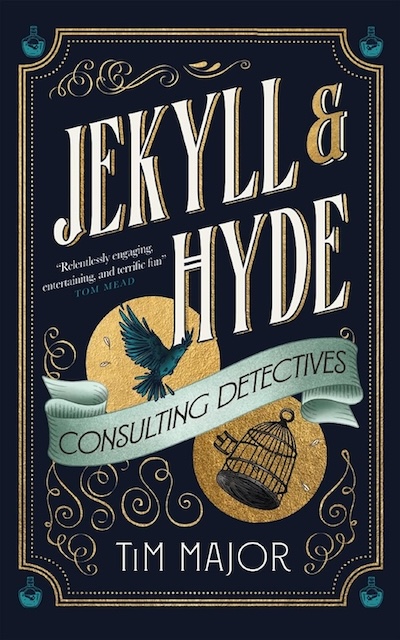
 In a couple of weeks (September 3rd), Titan Books will publish the latest novel from Tim Major, Jekyll & Hyde: Consulting Detectives. With an intriguing premise, this should appeal to fans of classic fiction mash-ups and mystery novels alike. To introduce the character(s) to readers, the publisher has provided us with the first chapter to share with you. First, though, here’s the synopsis:
When Muriel Carew attends a lavish society party, the last person she expects to bump into is her ex-fiancée Henry Jekyll, a man she’s not seen for many years. When Jekyll turns out to be investigating a series of missing persons in London, Muriel is intrigued. But Jekyll is not working alone, and if Muriel wants to aid in the investigation, she must work with both Henry and his partner, the monstrous and uncouth Mr Hyde.
As their search takes a dark turn and a missing persons case becomes a murder investigation, Muriel finds herself deep in a mystery involving a nefarious group exploring their own hidden alter-egos within the beating heart of London’s high society.
To solve the case and bring those responsible to justice, Muriel must find a way to place her trust in Mr Hyde, which might mean uncovering secrets about her own life she never dreamed of discovering.
*
Chapter One
Muriel considered all society parties lethally dull, but this one was worse than most. It was just as well that she had something to occupy her mind – otherwise, the anecdotes about Mayfair restaurants, home redecoration and inane gossip relating to anybody not present at the Courtenay residence that evening might have reduced her to a heap on the luxurious carpet, begging to be freed.
As it was, she was focused and determined. She accepted glasses of champagne whenever they were offered, but found hiding places for them after a single sip. She moved effortlessly from group to group, hovering at the periphery of conversation. In the dining room, a collection of wives wearing gowns far more elaborate than Muriel’s remarked on the décor of the house in tones that conveyed admiration, envy and subtle disdain. Whiskered gentlemen populated the library, grunting at one another while inhaling from cigars, and when they did speak it was only the typical remarks about foreign policy and the Marquess of Salisbury’s principle of ‘splendid isolation’, a concept that at this moment struck Muriel as particularly attractive. In the crowded corridor she paused outside the servery, where one maid instructed another that they had “best not scrimp on the gin cocktails – they’re set on being three sheets to the wind tonight.” She made her way into the large garden, where guests gathered in smaller groups, most of them intent on one another rather than paying any attention to the nominal centrepiece of the event: a plinth in the centre of the lawn upon which was a large plaster representation of a grand public building.
She stood alone before the model for several minutes, studying the tall Greek columns before its entrance and the towers at each corner that were as ornate as pagodas. Even though the model was unpainted, it seemed somehow garish, as well as a monstrosity.
“Fine-looking place, wouldn’t you say?”
Muriel nodded doubtfully. Without looking up, she said, “The name needs a bit of work.”
“The name?” the man said. “Does it have a name?”
She gestured at the plaque positioned in front of the model, which read St Simeon’s: Liberating Children from the Grip of Poverty.
Now she turned to see the man she was addressing. He appeared to be in his mid-sixties, and dandruff speckled his pale suit. He wasn’t looking at the plaster model, but rather up at the ivy-laced rear of Simeon Courtenay’s grand townhouse. The glass doors behind the twin balconies of the first floor were protected with geometric-patterned iron trellises. It seemed that their host was conscious of the need for security.
“I was referring to the school,” she said.
The man glanced at the model. “Ah, yes. I suppose it is rather an affectation, old Simeon using his first name like that. But there wasn’t a St Courtenay, as far as I know.”
Muriel smiled. “Did you know that there were three saints named Simeon? All of them were stylites – they lived up on tall pillars, fasting and preaching to people below. Our host may like the idea of being held up above others, but he hardly seems the pious type.”
She told herself she shouldn’t flaunt her knowledge. It was hardly expected of a woman. Then again, neither were critical opinions.
“Still – he arranged for all this, didn’t he?” The man waved vaguely at the model. “If it wasn’t for him setting up the charity, there’d be no school. I mean, in good time…” He drifted off. “Personally, I think we ought to be very proud of ourselves. My name’s Ingram, by the way. Not an insubstantial investor to the scheme, actually. And you are…”
Muriel laughed. “I’m nobody.”
“Then who are you with?”
“Just myself.”
They both turned as one of Simeon Courtenay’s house staff called out, “Ladies, gentlemen, would you be so good as to gather around the model?” He began to harry the groups scattered around the lawn, and Muriel listened attentively, hoping to add names to her list of donors to the charity or, even better, her list of perpetrators of the fraud.
“Mr and Mrs Hines?” the valet said politely to one couple. The Hineses had donated £100 and Muriel’s background research suggested that they were entirely well-intentioned.
“Please move this way,” the valet continued, “and stand just… yes, just there. Now, Captain Wright-Moss, if you would be so good.”
Captain Wright-Moss was of more interest. Earlier at the party Muriel had heard this stiff-looking man remark about a sizeable donation, but she knew for a fact that he was close to bankruptcy. Perhaps he might lead her to information about the gifts from anonymous donors that had been entrusted to the foundation, which hadn’t appeared on any public reports but about which Muriel had heard murmurings during other social events. If only she could get her hands on the statements relating to the building costs…
“Ah, Mr Ingram, Miss Carew,” the valet said brightly as he approached Muriel and her companion, “you’re in just the right place already, thank you so much.”
Muriel winced at the use of her name.
As other guests shuffled into place around them, Mr Ingram whispered, “You are Miss Muriel Carew?”
“I am,” she replied reluctantly.
“My goodness. I saw your name on the list of donors and I was surprised enough to remark to my wife—”
“I had asked for my name to be omitted,” Muriel said, doing nothing to disguise her frustration. “It was only a modest donation.” She resisted the temptation to add: I wouldn’t waste good money on a scam like this. The amount had been carefully calculated as the minimum that would ensure she would be invited to the party.
Mr Ingram continued, “I said to my wife, look here, that’s General Sir Danvers’ daughter!”
The guests were being encouraged to squeeze closer together as the photographer set up his tripod. Muriel experienced sudden claustrophobia, despite the warm air and the bright blue sky above.
“You knew my father?” she asked, her voice cracking slightly. Then she feigned laughter. “He wasn’t a real general, you know. He had a military bearing and the title just seemed to cling to him, like a nickname.” Conversely, the title ‘Sir’ seemed a downgrading of his status as a hereditary peer in the House of Lords. His precise position in England’s hierarchy had always eluded her.
“Indeed I did. I’m Ingram, of Ingram’s land agents. I performed the purchase of St Stephen’s Vicarage personally.”
The house represented another confusion of titles: in the past, many had assumed Muriel’s father was a man of the cloth, on account of his choice of the old vicarage in Canonbury as home.
She managed a weak smile. “I still live there.”
“I’m so glad to know that you do… despite your position.”
Muriel didn’t reply. The ever-tightening huddle resulted in her neighbour on her other side pressing uncomfortably into her bare shoulder.
“You must have been so very young when your father was taken from us.”
Muriel replied hollowly, “I was nineteen.”
Involuntarily, she thought of a grinning face, an empty house, a sense of the world shifting on its axis. She had been entirely lost that night, even before she had learnt of her father’s death.
“That was a decade ago,” she said, trying to clear her thoughts. “The pain diminishes, or perhaps I should say it crystallises. Either way, it’s smaller and can be worked around.” She had hardly noticed she was speaking aloud. She shook herself and said, “Now, let’s smile for this photograph, otherwise we risk appearing despondent over the building of a new school, which wouldn’t do.”
The valet stepped back but continued gesturing to coax those at the edges of the group inwards. Finally, he signalled that no more could be done, and the photographer disappeared beneath the cloth hood of his camera and held up a tray containing magnesium flash powder. Muriel gasped at the ignition of the flash, which was far brighter than she had anticipated. One of her neighbour’s responses was even more pronounced, and she turned to see who had made the stifled cry of anguish.
She didn’t gasp a second time. She couldn’t. All the breath had left her body.
The man who had been standing directly behind her hadn’t noticed her, and now he staggered away from the group, a hand pressed firmly to his forehead.
It seemed that the past refused to let her be.
“I’m afraid I must leave you now, Mr Ingram,” Muriel said, patting the land agent’s arm absently. “I’ve just seen a ghost.”
*
Tim Major’s Jekyll & Hyde: Consulting Detectives is due to be published by Titan Books in North America and in the UK, on September 3rd.
Also on CR: Interview with Tim Major (2020); Guest Post on “Genre Mash-Ups”; Excerpt from Snakeskin
Follow the Author: Website, Goodreads, Instagram, Mastodon, Twitter
 Civilian Reader