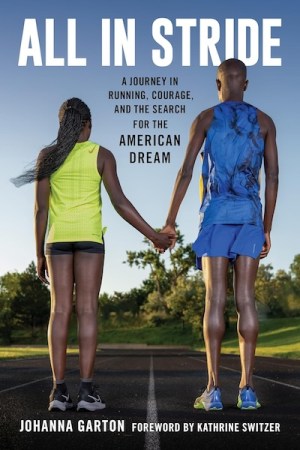
 Something a little bit different today: All In Stride by Johanna Garton is the story of two Kenyan-born distance runners who emigrated to the United States, and how they built a life in their new home country. Here’s the synopsis:
The inspiring stories of Kenyan-born distance runners Shadrack Kipchirchir and Elvin Kibet and their determination to build meaningful lives as American citizens.
Professional distance runners Shadrack Kipchirchir and Elvin Kibet grew up in rural Kenyan villages. Though their lives began in poverty, both were driven to reach their full potential, to gain an education and make a difference. And they would find their way to do just that through the high-pressure world of distance running.
In All in Stride, Johanna Garton tells the gripping and inspiring stories of Shadrack and Elvin. Beginning with their upbringing in Kenya, Garton follows the runners through their journeys to the United States, running for Division 1 colleges, their fated reunion during a track meet and blossoming romance, and ultimately their service as U.S. soldiers and professional runners.
More than just a running story, All in Stride takes readers behind the scenes to explore the difficulties Elvin and Shadrack faced, including adjusting to an entirely new culture in the U.S., bigotry and intolerance, the stresses and joys of global competitions like the Olympics, joining the U.S. Army’s World Class Athlete Program, and discovering the ever-changing landscape of what it means to be an American.
*
United States Olympic Track and Field Trials Eugene, Oregon
July 2016
Rising from a chair just inside the entryway, an event volunteer pulled the door closed. It had gotten stuck in the open position, allowing heat from the track to escape into the call room.
“Good green acres, thank you for keeping that baby shut,” mumbled another volunteer.
Outside, it was near twilight, but the temperature had risen above eighty degrees. The twenty-seven athletes competing in the men’s 10,000-meter final filled the room, each of them trying to stay relaxed. Puffy headphones piped in music for a few and blocked out what little noise there was inside the room. Several men stretched, loosening mus- cles and trying to ignore their competitors. For others, the only thing to do was close their eyes and visualize the race.
Shadrack Kipchirchir leaned forward, elbows on knees. Looking down at his legs, he took a moment to massage each one. The muscles gave way under his fingers as he kneaded, then shook out each leg and stood to take another lap around the call room. The vibe was intense, like nothing he’d faced competing in college for Oklahoma State. Each of the men in this room deserved to be here, their presence a testament to the years of work it took to achieve this level of athletic success. For most of them, the 2016 United States Olympic Track and Field Trials here in Eugene, Oregon, would be the pinnacle of their professional careers. Only the top three finishers in this race would make the Olympic Team and represent the United States in Rio de Janeiro the following month.
Shadrack intended to be among them.
He’d busted his ass the past two post-collegiate years, not to mention the past four weeks. His coach had taken him up to altitude in Mam- moth Lakes, California, with his teammates Paul Chelimo and later, Lenny Korir. They’d suffered through twice-daily workouts in thin, dry air that left them lying on the track gasping, their noses dripping with blood. It was, their coach said, the right kind of training to prepare them for the Trials. The same kind of training that the other top runners were undertaking, including the Nike-sponsored athletes now sitting in the call room with him.
“Just remember, Shaddy,” he’d been instructed, “they’ve got nothing on you and Lenny. Your workouts have been practically identical. The two of you’ve had the same training that they’ve had, and the only thing standing in your way now is what’s in your head. You’ve got this. Plus… you’re wearing the right singlet.”
That singlet now hung loose over black shorts with green trim. A camouflage print ran up the lower half where it met the upper, a pale green solid with the word ARMY stretching across the front in bold, black letters. It was a simple top, a contrast to what the other athletes wore, each of them sponsored by big-name shoe companies. Shadrack had once wondered if they’d considered signing him after college. A less than stellar showing at top races almost certainly ruled out a fancy running contract, but the more defining features were his name, the color of his skin and his birthplace, a traditional mud hut in rural Kenya. He presumed he was therefore at the bottom of the sponsorship totem pole.
Instead, he’d found a home in the United States Army, an unlikely but welcoming place for a recent grad with his background. His brother had preceded him, entering after his own college graduation, and now serving as a military vehicle mechanic. It was a decent option, and Shadrack had enlisted in the fall of his senior year of college, hearing only later that he could continue running in the Army if he met the time standard to be assigned to the Army’s World Class Athlete Program, also known as WCAP. Though this wasn’t what had inspired him to enlist, he’d gone for it, following the same path as any other recruit. Basic training, advanced training and then he’d met the time standard and was assigned to the WCAP unit, with Lenny and Paul not far behind. For eighteen months, they’d been stationed in Oregon, occasionally crossing paths with the Nike professional distance runners training nearby. Run- ning could be a lonely sport, but Shadrack felt a part of something bigger with the Army behind him.
“Hey, brother, you good?” Lenny whispered to him in Kalenjin.
Though the room was quiet, nobody noticed as the two of them stole a quick conversation. With only a couple minutes until the event volunteers led them to the track, talking to Lenny was a needed break in the tension.
“Yeah, I’m good. Just ready to get out there. The heat’s intense, man. Eighty-two degrees. Some of these guys are gonna crash.”
“No doubt. We’ll be okay, but nobody’s breaking any records today, that’s for damn sure. Hey . . . you know where anyone’s sitting?” Lenny asked.
“Nah. I told Paul they could get close if they wanted, but I doubt we’ll hear them. There’s 20,000 people out there screaming.”
“The only spectators that matter to me are those at the Pentagon,” Lenny said.
Both knew the importance of the race. If any one of the Army runners qualified for the Olympics in Rio, it would signal a turning point for the World Class Athlete Program. Plenty of American boxers and wrestlers had made prior Olympic teams wearing the Army jersey, but never runners. Shadrack nodded and looked over at the double doors leading to the track. One of the volunteers had cracked it open, walkie talkie in hand as he got word that it was time. Heat and noise trickled in again. Shadrack could see the edge of the track, red lanes offset with an infield of bright green turf. The low rumble of the massive crowd caught the attention of the other men in the room, and they began to take headphones off, shoving them into backpacks under each chair.
Taking one last sip from his bottle of fuel, Shadrack bent over to give the laces on his racing spikes one last tug. At 5’8” he was far from the tallest man in the race, but easily one of the leanest. Despite packing on the calories the past few weeks, the training had taken a toll and it was hard to keep close to the 120 pounds he needed for the strength to race well. His hair was cut short, buzzed close to his scalp. Deep-brown eyes took in the scene, and he glanced at Lenny one more time, flashing a final smile and offering a fist bump.
“Don’t let him go, Shaddy. Just don’t let him go,” Lenny said in English now, soft enough that nobody heard.
The event volunteer stationed at the door looked up and spoke in a loud voice. “It’s time now, men. Let’s go. Top six . . . don’t forget you’re back here for drug testing when you’re done.”
Swinging wide, the double doors opened and with it the heat, the crowd noise, the smell of the rubber track baking, and the offer of prom- ise and agony for the next half hour.
The stadium announcer’s voice broke through the noise as the men stepped from the call room onto the asphalt foyer leading to the track.
“Now entering Hayward Field are your competitors for the final of the men’s 10,000 meters. Six point two miles.”
Walking into the light, Shadrack looked up at the stadium seating.
Somewhere out there was his teammate Paul, most likely talking pre-race strategy a mile a minute to anyone who’d listen, including Shadrack’s wife Elvin. It pained Shadrack to think of what she must be going through. Watching him race was stressful, and he knew she could tell that he’d been lying when he told her he’d play it conservative tonight for the first half of the race. There was practically no chance she wouldn’t spend the race pacing to and from various points in the stadium.
Elvin Kibet’s running accolades nearly matched her husband’s. She’d been his biggest cheerleader for years and knew this world just as well as he did. Once the race started, she knew the feeling of settling into a rhythm, listening to both body and legs. She suspected she’d be able to tell once Shadrack started the race how he was feeling and what his game plan was. The two of them could’ve had entirely different lives in Kenya, but somehow, they’d ended up here in the United States, together. She knew his life and his running better than anyone, no matter what country they were in. The other men on the track surely had faced obstacles to get here tonight, but she believed what she and Shadrack had sacrificed together would count for something.
Elvin heard the call to the start line from the stadium announcer as she was leaving the bathroom. Her former college competitors were swarming the halls of Hayward Field, making things more stressful. If she could just make it to her seat without anyone recognizing her or wanting to talk, all would be well.
Elvin twisted long braids around her fingers as she found her seat. The tank top she wore was already damp from stress and clinging to her 5’0″ frame. She caught Paul’s eye as she passed his row, several in front of hers.
“You made it,” he said, nodding to her.
She paused, noticing how many Army officials had come for the race. They filled up the seats in this small section, eyes glued to the track as the athletes found their lanes. It was a walk Elvin knew from taking it herself many times in college. She could put herself in Shadrack’s shoes, a mix of nerves but peace in knowing the hard work was done. Arriving at the starting line uninjured and in top shape signaled he was ready.
“I did make it, which I’m counting as a victory,” she said to Paul. “You guys have worked so hard. I just want this to go well.”
“He’s got this, Elvin. He was born for this. Just watch,” Paul replied. Elvin nudged into her seat. Shielding her eyes from the last of the day’s bright sunlight, she wondered if her husband knew exactly where she was sitting.
The athletes were taken to the starting line, one group slightly ahead and further out on the track than the other. Shadrack gave quiet thanks that his group was starting in a shaded section on the track, allowing a few additional minutes of protection from the sun. I’m not going to let the Army down, he thought. They’ve given me everything. With the announcer continuing introductions, each runner dusted off jitters, shaking out arms and legs.
“Representing the United States Army, please welcome Leonard Korir and Shadrack Kipchirchir.”
Polite claps gave way to bigger cheers as the next runner was introduced.
“He was a silver medalist in the 1,500 meters at the 2004 Athens Olympics, and here to try to make his fifth Olympic team, it’s Bernard Lagat!”
Shadrack looked over and smiled at Bernard. They knew each other well. At forty-one, track fans weren’t convinced he had enough in the tank to make the top three spots, but Shadrack knew the kind of grit Bernard had.
“Also, please welcome former Oregon Duck and silver medalist in this event at the 2012 London Olympics, Galen Rupp!”
This was Galen’s home track, and it was apparent. Everyone in the crowd was pulling for him. Shadrack had studied race videos night after night for months, preparing his strategy and becoming comfortable with the race tactics he knew were about to be unleashed. Galen was at the top of his game, and Shadrack knew if he could just hang onto him, he’d be sitting on the Olympic team. Galen turned around, waving at the 20,000 adoring fans on all sides. The last to be introduced, he toed the line and waited for instructions.
“All right, men, let’s have a clean race,” the starter yelled.
He stood on the infield, two steps up on a riser. Lifting his right arm, a starting pistol pointed to the sky. A slight pause stilled the crowd, then the command “Set,” and with the starting shot, a puff of white smoke dissipated over the infield. The two groups of athletes converged after a hundred meters, settling into an easy pace. Rhythmic clapping greeted the pack as they came around the first lap, followed by more words from the stadium announcer.
“Twenty-five laps around the track for this race,” he said.
Shadrack tried to calm his mind as the first few laps passed. Jostling for position, the pack of men watched the race clock with every lap. Sweat covered each of them, and as arms grazed one another, it mixed in slippery patches. One lap at a time, Shadrack thought. You’re here to fight. He imagined himself an hour from now, discussing where to order pizza and sliding into the passenger seat of his coach’s yellow Corvette. Breathing from the other men quickened as they finished the first four laps marking a mile. A volunteer stood in the fourth lane, just outside the pack as it came around the bend. She held cups of water, arms out- stretched. Shadrack thought about how out of place she looked here, as if it were a turkey trot. Any one of these men running sub-five-minute miles would never have the desire to stop for water at this pace, despite the heat.
Six laps in, Galen picked up the pace. Shadrack hung back, aware of Galen’s strategy to create distance on the field but not yet ready to take the bait. He saw Galen’s coach behind the blue fencing, shooting Galen a look as he passed. Within seconds, the group was back together as Galen slowed. The men could feel each other grinding, and as they reached the halfway mark, the field began to stretch out. Unrelenting, the sun refused to hide, and several of the runners began to falter. Shadrack tried to channel himself back to the days in Mammoth Lakes—Lenny and Paul grunting on either side, the three of them collapsing on the dirt path at the end of their fifteen-mile runs at noon. Stealing a glance on the turn, he saw Lenny still in the hunt ten yards behind him. Hallelujah, brother. Don’t go anywhere. I need you.
With twelve laps to go, Galen pulled away again. It was the move Shadrack had prepared for. He was in the big leagues now, and Galen was the best in the business. Shadrack could feel the crowd watching as they tried to see who’d respond. He knew they’d be scrambling if he fol- lowed, looking in their race booklets to try to figure out who he was. At the moment, he was just another runner with the phrase “Kenyan-born” forever attached to his profile.
Predictably, Bernard Lagat gave chase, passing Shadrack and catching up with Galen. Bernard and Galen were Nike teammates and had likely worked on this plan a hundred times.
Shadrack considered his options, which weren’t plentiful. In a matter of seconds, the distance between the Nike duo and the rest of the pack would grow. With it, any chance of hanging on would disappear. His spirit would be crushed. Shadrack looked up, and seeing an American flag flying over Hayward Field, he accelerated, reaching for the unknown.
*
Johanna Garton’s All in Stride is out now, published by Rowman & Littlefield in North America and in the UK.
 Civilian Reader