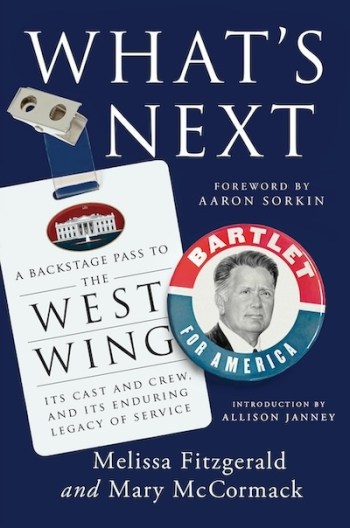
 Behind-the-scenes at the creation of The West Wing…
A behind-the-scenes look into the creation and legacy of The West Wing as told by cast members Melissa Fitzgerald and Mary McCormack, with compelling insights from cast and crew exploring what made the show what it was and how its impassioned commitment to service has made the series and relationships behind it endure.
Step back inside the world of President Jed Bartlet’s Oval Office with Fitzgerald and McCormack as they reunite the West Wing cast and crew in a lively and colorful “backstage pass” to the timeless series. This intimate, in-depth reflection reveals how The West Wing was conceived, and spotlights the army of people it took to produce it, the lifelong friendships it forged, and the service it inspired.
From cast member origin stories to the collective cathartic farewell on the show’s final night of filming, What’s Next will delight readers with on-set and off-camera anecdotes that even West Wing superfans have never heard. Meanwhile, a deeper analysis of the show’s legacy through American culture, service, government, and civic life underscores how the series envisaged an American politics of decency and honor, creating an aspirational White House beyond the bounds of fictional television.
What’s Next revisits beloved episodes with fresh, untold commentary; compiles poignant and hilarious stories from the show’s production; highlights initiatives supported by the cast, crew, and creators; and makes a powerful case for competent, empathetic leadership, hope, and optimism for whatever lies ahead.
I first discover The West Wing during my first month at university (many moons ago…). It was an episode from the second season, and I was immediately hooked. At the time, my interest in US politics was not as developed as it would go on to become. Those first episodes, though, grabbed my attention in a way I don’t think anyone would have expected. Every year, from 2001 until 2016, I watched every episode that was available. So, when I learned that What’s Next was on the way, I knew I had to read it. Luckily, the publisher provided me with a review copy, and I dove right in.
In so many ways, The West Wing was a show that shouldn’t have become what it did. “What had started out as a smoke break in Aaron Sorkin’s basement, an idea based on a movie poster pointed out by a friend”, followed by a meeting in which creator Aaron Sorkin was put on the spot turned into a bit of a juggernaut. At the time, almost everyone involved knew, as Sorkin tells the authors, that “there was no way a network was going to put this on the air. Shows about politics didn’t work.” In part, this is because of the historical record — shows about politics had pretty much all tanked. At the same time, at the time that the show was germinating and in the lead-up to its debut, public impressions of government, elected officials, and the presidency were… not great. (Oh, what innocent minds we were, back in the waning days of the 1990s…)
For those familiar with Sorkin’s work, they will be unsurprised to learn that some of the idea for The West Wing, and one of the reasons the writer was able to get into it, was his research and work writing The American President. A very good movie about a widower president who ends up falling for a fiery journalist, it featured many of the romantic ideas about public service that would come to define The West Wing. Typical for Sorkin, too, “his first draft of The American President had been extremely long” — too long to be turned into a movie. While feature screenplays tend to run 90-120 pages, Sorkin’s draft for his film was 385 pages. [I really want to read that draft.] Anyway, one can imagine that there were plenty of unused ideas in that epic draft to mine for the new show. (And, indeed, we’re told over the course of What’s Next that there were.)
Like many oral histories of TV shows, a fair bit of the book focuses on the genesis and creation of the show — those early days of writing, casting, crewing, and filming the pilot; developing the feel and “language” (actual and visual) of the show; and ultimately getting it on the air. I found this the strongest portion of the book, with plenty of input from Sorkin, Schlamme, Roth, and the cast. It was also interesting, and a bit surprising, to learn of the many connections between multiple cast and crew members and Sorkin’s past work (on stage and screen).
I’ve mentioned this before on CR, but I am very much enjoying what seems to be a bit of a moment for entertainment oral histories — Modern Family, The Office, The Big Bang Theory, and The O.C., for example, have all been the subjects of oral histories published in the past few years. Adding one about The West Wing just makes sense, in my opinion. It does, however, arrive in quite a different situation as those other books. Despite being a show that aired before life was very online, and before behind-the-scenes stories and gossip was everywhere, The West Wing is nevertheless a show for which a lot of content is already available. For example, the excellent podcast series The West Wing Weekly — co-hosted by Joshua Malina, who plays Will Bailey on the TV show.
This context, I think, is important when going in to What’s Next. As the authors state at the beginning, they didn’t intend for this book to be the definitive history of the show, but rather they wanted to share memories and stories from the creation of Aaron Sorkin’s show, and also examine some key episodes that set the tone and ethos of the story. The book is also about service — perhaps unsurprisingly, given that TWW is the story of dedicated public servants, doing their best, the authors, actors, and others share stories about their own activism.
“As we relive classic moments from The West Wing, as you virtually walk-and-talk with your favorite White House staffers, we’ll periodically regale you with stories about our service journeys, like participating in campaigns and advocating for issues we care about.”
The authors are able to draw on a wealth of sources for their book — plenty of interviews, podcasts, and DVD extras (commentaries and interviews) are referred to. They also, of course, draw extensively on new interviews with the cast and crew (and their own memories). There will, therefore, be plenty of new content for “wingnuts” who maybe think they know everything. There are so many great tidbits sprinkled throughout the book. For example, the “set-dressing” of Gail’s fishbowl (there were 50-60 themes used, of which I think I only remember… five? I’ll have to go back and re-watch the show to spot some more). There are also plenty of references to long-standing West Wing — for example, the ongoing “feud” between Joshua “I can’t act! I’m a terrible actor” Malina and Bradley Whitford (Josh Lyman on the show). Apparently, Malina was a bit of a terror on set — a relentless prankster.
Two of the cast receive a lot of love — justifiably, of course. There were many moving memories of John Spencer (Leo McGarry), who passed away during the filming of Season 7. The authors take readers through their and others’ experiences around this time, and how the show was used to help mourn “Spence” and Leo. I don’t think I’d ever read so much about Spencer (who I think I first saw in 1990’s Green Card, but it was 1996’s The Rock when I properly “noticed” him for the first time). There is also a lot of love for Martin Sheen (President Bartlet), who very clearly set the tone for the set — by all estimations, he is beloved by everyone he works with and for. If, after finishing What’s Next, you want to learn more about his life and career, I would highly recommend Along the Way, his joint-memoir with his son, Emilio Estevez.
Despite all these great moments in the book, I did find myself wanting more. It has the feel of a series’ final yearbook. It’s fun, it’s light, and it’s clear that everyone involved still loves and respects their colleagues. As I mentioned, the authors were writing the book with a mountain of other, more in-depth TWW content available, so they had a tricky task to ensure that they provided something new and original, adding to the conversation and historical record of the show that means so much to so many people. (See, for example, the chapter featuring West Wing memories from multiple people working in government today — from assistants to senators). Similarly, it would have been possible to write an absolute door-stopper of a book, which may have satisfied the most die-hard of wingnuts, but maybe have been far too much for a more-general audience.
So, I would absolutely recommend this book for any self-identifying wingnut, but also for anyone who enjoyed the show and finds themselves wanting to know a little more. It may also serve as a jumping off point to the West Wing Weekly podcast — complete, but also a potentially daunting listening task to embark on, at this point. (It is, however, excellent, and I do very much recommend giving it a try.)
What’s Next is not as exhaustive as some of the oral histories I mentioned earlier in the review, but it does have plenty to offer readers and fans of the show. It was, also, a pleasant walk-and-talk through the corridors of the show, and brought to the surface so many of my memories from watching it, and how it inspired my own interest in US politics. (It is, as I told my examiners, one of the main reasons I pursued a PhD in US foreign policy.)
*
Melissa Fitzgerald & Mary McCormack’s What’s Next is due to be published by Dutton in North America, on August 13th.
Follow the Authors (Fitzgerald): Goodreads, Instagram, Twitter
Follow the Authors (McCormack): Goodreads, Instagram, Twitter
 Civilian Reader