 An engaging, entertaining journey through the world of crypto, from boom to bust
In 2021 cryptocurrency went mainstream. Giant investment funds were buying it, celebrities like Tom Brady endorsed it, and TV ads hailed it as the future of money. Hardly anyone knew how it worked — but why bother with the particulars when everyone was making a fortune from Dogecoin, Shiba Inu, or some other bizarrely named “digital asset”?
As he observed this frenzy, investigative reporter Zeke Faux had a nagging question: Was it all just a confidence game of epic proportions? What started as curiosity — with a dash of FOMO — would morph into a two-year, globe-spanning quest to understand the wizards behind the world’s new financial machinery. Faux’s investigation would lead him to a schlubby, frizzy-haired twenty-nine-year-old named Sam Bankman-Fried (SBF for short) and a host of other crypto scammers, utopians, and overnight billionaires.
Faux follows the trail to a luxury resort in the Bahamas, where SBF boldly declares that he will use his crypto fortune to save the world. Faux talks his way onto the yacht of a former child actor turned crypto impresario and gains access to “ApeFest,” an elite party headlined by Snoop Dogg, by purchasing a $20,000 image of a cartoon monkey. In El Salvador, Faux learns what happens when a country wagers its treasury on Bitcoin, and in the Philippines, he stumbles upon a Pokémon knockoff mobile game touted by boosters as a cure for poverty. And in an astonishing development, a spam text leads Faux to Cambodia, where he uncovers a crypto-powered human-trafficking ring.
When the bubble suddenly bursts in 2022, Faux brings readers inside SBF’s penthouse as the fallen crypto king faces his imminent arrest. Fueled by the absurd details and authoritative reporting that earned Zeke Faux the accolade “our great poet of crime” (Money Stuff columnist Matt Levine), Number Go Up is the essential chronicle, by turns harrowing and uproarious, of a $3 trillion financial delusion.
It seems like I’ve been reading a lot about crypto, recently. I remain deeply skeptical of the whole “industry” (but then, I’m not a huge fan of gambling or scams in general). Zeke Faux’s Number Go Up seemed to have been very well-received, so I decided to take one more dip into the subject. I was not disappointed: this is a very well-researched and written book, not to mention entertaining and engaging throughout. I really enjoyed it.
A couple of years before writing this book, BusinessWeek asked Faux to investigate Tether, a so-called “stablecoin”. This started the journalist on a journey into the wider (and growing) world of crypto. Convinced Tether was some kind of scam (an understandable stance), Faux started by investigating Tether’s “laughably-weird founders”, and hunting for the “billions of dollars of reserves that it claimed it had”. The author’s initial impression seems to be wholly borne out — not only by Faux’s own investigations, but by everything I’ve read or found about the company. The author’s research would take him much further afield than this one company, though, and he would learn and see how the crypto-ecosystem has come to penetrate many other countries’ economies (legally and illegally) — over the course of his research, he came into contact with such salubrious innovations as “scam compounds” and “pig butchering”, for example.
Despite the fact that Sam Bankman-Fried features on the cover of Faux’s book, Number Go Up is not a profile of SBF. The now-sentenced founder of Alameda and FTX doesn’t come close to dominating the narrative, but he does make frequent appearances — this, to me, just highlights how intertwined his operations were across the crypto economy. As maybe one of the most famous crypto-bros, though, his aesthetic is a familiar one for many — it’s basically the same as Zuckerberg’s, during the early years of Facebook, but even here some other people mentioned by Faux take things further, and seem to revel in being even more disheveled than others, as if it were some kind of achievement. Faux gives plenty of attention to other (bad) crypto actors who have managed to skate by far less-scrutinized. Bankman-Fried does emerge more prominently in the final chapters, as Faux covers the sudden crash of his firms. Chapter 22, “Assets Are Not Fine”, covers FTX’s collapse — “the shocking reversal was the biggest news that crypto had ever seen”. The collapse was, in the author’s framing, a case of “reverse FOMO” following CZ’s drive-by warning Tweet, leading to a crypto-bank-run (which many saw as just proof of a massive fraud). Faux had thought Tether would ultimately crash, but it was SBF’s exchange that was spectacularly taken down; “FTX had seemed to me like a crypto-casino, which lured investors to gamble on made up coins and scams. But I hadn’t suspected that the casino’s counting room was short on cash.”
The book offers many examples of SBF’s and other crypto-evangelists’ and founders’ “casual attitude toward rules”, which is ultimately the cause of much of the damage they have done in the global economy — not to mention the personal, individual damage they have left in their wake, fleecing unsuspecting investors of their hard-earned savings (something that ticked up during the pandemic, as more people were stuck at home with not much to do, looking for ways to grow their savings and retirement funds).
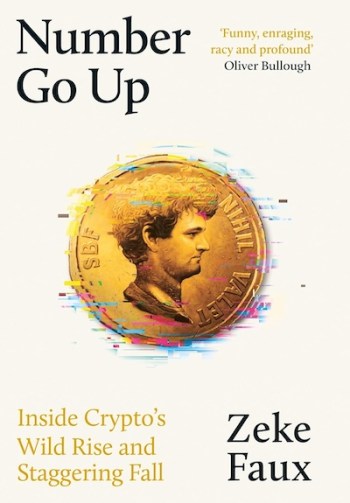 Faux offers a broad and wide-ranging approach to the world of crypto. From bitcoin to NFTs, the author takes readers on an oft-funny journey through the various crypto ecosystems, and lays bare all that is ridiculous about the “products” and also the people who create and boost it. The portion of the book about Faux’s dabbling in the world of Bad and Mutant Apes is often hilarious, entirely depressing, and absolutely ridiculous (not to mention moronic, at times). Faux commits to his project far more than I ever could, buying his own Mutant Ape in order to be accepted into the world, meet the players, and attempt to figure out… well, what the fuck is this all about? The author also commits to hands-on experience with crypto, and learns a lot about how Tether (and other) coins are acquired, used, etc. (It sounds exhausting, clunky, and extremely inconvenient — not to mention, expensive and rife with fees and other forms of friction.)
The final quarter of the book examines the ways crypto is working its way into the legal and illegal economies of countries around the world. The rise of the aforementioned “scam compounds”, are a particularly dark development. (“With gambling, came crime.”) There’s also mention of certain bizarre and ridiculous ways in which people have fallen for the evangelical pitches and celebrity endorsements — for example, the proposed “bitcoin-mining volcano” in Venezuela.
In the final chapter, Faux accepts some blame for the small part that he played in helping to build the myth and mystique of Sam Bankman-Fried. The author acknowledges that, in a profile he wrote about SBF, he “flew right past the bright red flags at his company: its lack of corporate governance, the ties to his hedge fund, its profligate spending on marketing, the fact that it operated largely outside U.S. jurisdiction”. This is an important admission on Faux’s part — even though this book intelligently excoriates SBF, and crypto in general, this comment goes some way to highlighting the widespread acceptance of Bankman-Fried’s supposed genius, and how far-too-many people who should have known better just swallowed the PR that he was “the only honest man in crypto”, committed to effective altruism (despite a general lack of evidence). Luckily for both Faux and, therefore, the reader, the profile likely gained Faux access after the collapse — an interview that informs the final chapter, and damning SBF once again with his own words.
In light of the author’s admission, his comments about Michael Lewis seem just a little bit unfair. It’s becoming a bit cliché and tired to mention Lewis in any article or review of crypto-related books (not to mention in the books themselves), but given Lewis’s appearances at conferences, and less-than-skeptical approach to covering the characters in question, it’s somewhat justified. Faux’s account of his discussion with Lewis after a now-infamous, fawning on-stage conversation with SBF, was disappointing for this fan of Lewis’s books. Faux’s surprise and disappointment that Lewis wasn’t more skeptical of the crime-related aspects of crypto are valid, but then Faux also bought into SBF’s myth — perhaps Faux’s disappointment is more a result of hindsight, given what he went on to discover about the darker aspects of the crypto industry.
Like Lewis, Faux allows many of his subjects damn themselves with their own words; unlike Lewis, Faux is perfectly happy to editorialize as well, and his sharp wit serves him very well, highlighting the general absurdity and the cringe-inducing, awkward, asinine, and/or frat-boy-style of many crypto-world denizens. Anyone who thought Lewis’s Going Infinite wasn’t critical enough of SBF (a fair, although I still think misplaced, criticism) and crypto in general, you’ll probably find what you were looking for in Faux’s book.
Sidenote: I’d be really interested in a discussion between Faux, Lewis, Ben McKenzie and Jacob Silverman (the latter are authors of Easy Money, which is another highly recommended book about crypto). That could make a pretty great podcast episode, I think.
This is the third book about the crypto world that I’ve read, and I think it may be the most entertaining and engaging. McKenzie & Silverman’s and Lewis’s are also very good, offering different approaches to the scams and scammers involved. If you are interested in learning more about the subject, then I think these are the three books you should read (or choose from — I know many people have far lower tolerances for this content). Also, having read these three books, I think I’m good, now: I don’t need any more convincing (or confirmation) that my low opinion of crypto is entirely correct.
A comment about the audiobook edition: Dan Bittner’s narration is excellent.
Number Go Up is highly recommend for the crypto-skeptics. It is also recommended for those who haven’t yet formed an opinion (this book — and McKenzie & Silverman’s — will likely save you money). A well-written, engaging and entertaining book.
*
Zeke Faux’s Number Go Up is out now, published by Crown Currency in North America and W&N in the UK.
 Civilian Reader