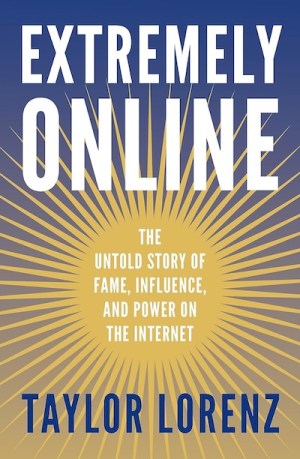
 An excellent history of how internet influencers and creators changed the way we socialize and interact online
For over a decade, Taylor Lorenz has been the authority on internet culture, documenting its far-reaching effects on all corners of our lives. Her reporting is serious yet entertaining and illuminates deep truths about ourselves and the lives we create online. In her debut book, Extremely Online, she reveals how online influence came to upend the world, demolishing traditional barriers and creating whole new sectors of the economy. Lorenz shows this phenomenon to be one of the most disruptive changes in modern capitalism.
By tracing how the internet has changed what we want and how we go about getting it, Lorenz unearths how social platforms’ power users radically altered our expectations of content, connection, purchasing, and power. In this “deeply reported, behind-the-scenes chronicle of how everyday people built careers and empires from their sheer talent and algorithmic luck” (Sarah Frier, author of No Filter), Lorenz documents how moms who started blogging were among the first to monetize their personal brands online, how bored teens who began posting selfie videos reinvented fame as we know it, and how young creators on TikTok are leveraging opportunities to opt out of the traditional career pipeline. It’s the real social history of the internet.
Emerging seemingly out of nowhere, these shifts in how we use the internet seem easy to dismiss as fads. However, these social and economic transformations have resulted in a digital dynamic so unappreciated and insurgent that it ultimately created new approaches to work, entertainment, fame, and ambition in the 21st century.
This is another review I meant to write far sooner, but one that fell off my radar due to work. As with the other (S. A. Cosby’s All the Sinners Bleed), it’s a review of an excellent book. For anyone who’s spent time online over the last few decades, Extremely Online offers a fantastic, accessible and engaging history of how the social internet developed — even for those who are not extremely online.
I only became interested in producing my own online content when I was at journalism school, and a professor introduced the class to Blogger (this would have been late 2005, early 2006). As a result, I missed some of the earlier trends and platforms that Lorenz covers in Extremely Online. I was, however, somewhat familiar with them — if nothing else, because people still wrote about them even after they had started to fade away.
Lorenz’s book covers a full sweep of online content creation and the monetization thereof (they really can’t be separated), showing readers how groups of extremely online personalities and creators embraced different platforms. The author explains, and clearly shows, how social media platforms removed many of the traditional gatekeepers (albeit, sometimes creating some of new ones of their own), and in some ways democratized entertainment, celebrity, and side-hustles. The book isn’t just a celebration of social media — Lorenz is clear-eyed about the potential pitfalls of these platforms, and the ways in which they can be used and abused by bad actors — for example, “we face a grave contagion in the form of disinformation and hate by influencers who otherwise would have been constrained by the limits of budget and public access.”
Rather than walk through each one in this review, I want to look at some of the things that Lorenz brings to light. Specifically, that Silicon Valley/app creators really have no idea how their apps will be used once released into the digital wilds. For almost every platform Lorenz writes about, it’s the users who end up dictating what the platforms are used for and how they are used — from Vine, to YouTube, to Twitter, and Instagram, users took each one and made it something unexpected. (Especially, it seems, in the case of YouTube.)
“While the mythology around Silicon Valley featured young men who could see the future better than everyone else, what the rise of social media thus far had proven was that nearly all of those young men had been wrong. They each built a platform with the confidence that it would do one thing better than anyone else, only to be redirected and rescued by a community of creative users.”
As the platforms grew, the money arrived. Starting at a time when “sponsored content” was considered a bit gauche, “Advertisers and creators were shocked. Not only did their followers not seem to care that their posts were sponsored, some actually engaged with sponsored content at an even higher rate when labeled as such.” In the early days, this was because “audiences actually thought it was cool that brands they knew and respected were working with creators that they respected and followed,” according to one advertising professional. Now, of course, it has just become the norm and every seemingly every famous person now shills for products and services — many of which they probably don’t really use when the cameras are put away.
However, the world has become inextricably interconnected, as well as dominated by many of these “influencers” — that is, those who are able to rise about the cacophony of others, and gain traction amongst larger audiences (usually by going viral for something). While I am less convinced that mainstream media is obsolete and dying (I’ll concede it is certainly struggling), Lorenz makes many valid points about how social media has changed the ways traditional media has to operate — at least online, if not in toto.
“When one thinks of ‘the media,’ they often think of broadcast news and newspapers; in reality, creators are ‘the media’ of today. The media landscape that they dominate is only becoming more digital and more distributed. Cycles of virality are accelerating. Online influence can make you an overnight Hollywood sensation, morph you into a powerful business leader, or take you to the White House. These shifts will only be compounded with technological advances such as the rise of AI. Legacy institutions that refuse to adapt will continue to fade into oblivion.”
To sum up, Extremely Online is an excellent history of online media. It offers a fond and nostalgic look at the early days, a sharp examination of contemporary trends (and how we got here), but also a clear-eyed understanding of its weaknesses, faults, and potential dangers. Very highly recommended to anyone interested in technology, culture, and media.
*
Taylor Lorenz’s Extremely Online is out now, published by Simon & Schuster in North America and WH Allen in the UK.
Follow the Author: Website, Goodreads, Instagram, Twitter, Substack
Review copy received via Edelweiss
 Civilian Reader