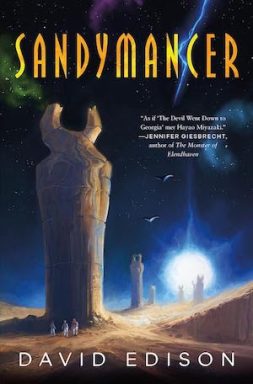
 Today, we have an excerpt taken from David Edison‘s second novel: the fantasy-science fiction mash-up Sandymancer. Due to be published next month by Tor Books, let’s first check out the synopsis:
A wild girl with sand magic in her bones and a mad god who is trying to fix the world he broke come together in SANDYMANCER, a genre-warping mashup of weird fantasy and hard science fiction.
All Caralee Vinnet has ever known is dust. Her whole world is made up of the stuff; water is the most precious thing in the cosmos. A privileged few control what elements remain. But the world was not always a dust bowl and the green is not all lost.
Caralee has a secret — she has magic in her bones and can draw up power from the sand beneath her feet to do her bidding. But when she does she winds up summoning a monster: the former god-king who broke the world 800 years ago and has stolen the body of her best friend.
Caralee will risk the whole world to take back what she’s lost. If her new companion doesn’t kill her first.
Intrigued? Read on for the first chapter of Sandymancer…
*
Chapter 1
The day the monster stole Caralee’s future started out as dull and shiny as any other—with children and young folk scattered around the sandy circle that served as a gathering place for the families of the nameless village. In this half-ruined amphitheater, they took their lessons from a woman dressed in undyed linen, her head, neck, and chin wrapped about with a threadbare gorget. Later, most would return to the cable fields with their elders, or stay within the village for piecework and other chores.
Caralee sat cross-legged on her favorite schooling seat, smiling at the crack in the sky. An age ago, her seat was a column; now only the plinth remained, scoured smooth by centuries of sandstorms into a seat-shaped groove that cradled Caralee’s bottom just so. The stone fit her far better than her burlap shmata ever would.
Marm-marm pointed at the fractured sky. The morning sun rose above the horizon, gold and brilliant, but the sky, she’d taught them, was far too dark. Once, it had been a much lighter blue, which was a color Caralee found difficult to imagine so far above and in such quantity. Wouldn’t that be awfully bright? She’d learned that when the sky had been light blue, the stars had been invisible during the day. That, too, she struggled to imagine.
The crack in the sky looked like frozen lightning, jagged and forking. At noon, when the sun passed behind it, you could see that the crack was four or five times longer than the sun.
Other students lazed or whispered, but Caralee leaned forward, elbows on her knees, eager to answer Marm-marm’s questions and ask her own.
“Who can tell me about the sky?” Marm-marm shielded her eyes from the sun with one hand while pointing with the other, tracing the lines over her head. “Is it broken? Why is it broken? How is it broken? How can we tell that it’s broken?” Marm-marm always asked too many questions at once, which was Caralee’s favorite thing about the woman. Caralee never said that to her face. That would clam up Marm-marm’s curious mouth, which was the last thing Caralee wanted on any day.
“Mphh!” Fanny Sweatvasser grunted through a mouthful of her own hair, then wicked her wet curls out from between her teeth so she could offer up one of her habitually bizarre answers. “A mightily infestatation of metallicky creatures”—Fanny pronounced the word cree-aht-choors, which gave Caralee a headache—“crawled from their nests—their nests are the stars—and are a-spinning their bea-ut-iful cobbyweb across the sky.” Fanny hunched her shoulders and gazed at the sky with delighted horror. “They want to catch the sun and steal away its light until it’s as wee as a star. Then they’ll hatch more cre-a-tures from that star and lay eggs in our brainpans with their rustipated penises.” Fanny spread her lips in what would have been a smile if it hadn’t been as flat and haunted as the wasteland horizon. “That, Marm-marm, is my answer.”
“Oh, Fanny.” Marm-marm looked like she’d swallowed some vomit. “Can anyone offer a less, hmm—a different answer?”
“Hey, Fanny,” sassed Diddit Flowm, bouncing his knee. “If your stupid star-critters are gonna hatch from the sun, then why’re they gonna put eggs in our heads? That makes no sense.”
His friends smirked, and Caralee laughed to herself. For Diddit, that was a truly massive amount of insight.
“I asked for an answer, Diddit Flowm.” Marm-marm scolded the boy without much enthusiasm. “A little help, Caralee?”
Caralee wanted to point out that, as usual, Fanny had taken a tiny grain of truth—tiny, mind you—and ran away with it, returning with something so ridiculous that the truth could no longer be found. But Marm-marm had asked her for answers, and Caralee loved answers.
“Well, Mag says that the crack in the sky used to be a little thing.” Caralee didn’t have facts, so she began with observations. Caralee had been raised by Mag, alongside her grandson, Joe Dunes, and was the wisest person Caralee knew, even if she didn’t have as much book learning as Marm-marm. “Mag also says that the sky was lighter during the day, although I don’t see how that would work. I mean, how would we—”
“Yes, Caralee, thank you.” Marm-marm always called on Caralee, but never let her finish. “When Old Mag Dunes was wee, that-uppa-there crack was wee, too, and the day sky shined bright blue.”
The other students oohed at the thought of such a pretty, bygone sky, but
Caralee liked the crack below the sun. It was interesting, a commodity in short supply, here at the fringes of the wasteland. She loved the sky, with its stars peeking through their darkly colored veils.
“And,” Marm-marm pressed her advantage. “We couldn’t see the stars whenever the sun came out. Back then, the sky only darkened to shades of indigo near dawn and dusk.”
“What’s a findigo?” asked a boy with wild hair and one eye that was always staring at his nostrils.
“Anyone?” Marm-marm asked the seated students, propped up on stone blocks and other remainders of the Land of the Vine. “What, asks Marmot Kleyn, is findigo?” She scanned the faces of her students, most of whom were still sleepy, and cared little for learning. Caralee waved her hand high, but Marm-marm gave the rest of the class a few seconds to catch up, if any were so inclined. They were not. “Yes, Caralee?” She braced her hands on her hips and stretched her weary back. “You can put your arm down, girl. You know full well that you’ve no competition here.”
Don’t call me “girl” is what Caralee almost said, but thought better of it. She grabbed her arm like a separate thing and dragged it into her lap as if it had a mind to shoot up and start waving again.
“Yes, Marm. For starters, ‘findigo’ ent anything, but indigo, was a plant—and it’s a color, too. It sits right between violet and blue, on the rainybow wheel.” Which we learned last year and there are only seven scatting colors to remember, she thought but also did not say.
“That’s right. Now, can anyone tell me why a crack in the sky and a darkening sky might be connected?”
“Well,” Fanny began, and Caralee suspected that she was not about to answer Marm-marm’s question. “First of all, the rainybow wheel was invented by the droods to hide the fact that they keep all the green in one super-secreted underground well, excepted for water, it’s got green. All the greens.”
“No, Fanny, just no.” Marm-marm pressed her hands to the sides of her head, fidgeting with the wrapped burlap gorget that hid her neck and cheeks. “If there are still droods in the world, they may not be singing fruit from treebones anymore, but they have most certainly not stolen all the green and hidden it in an underground well.”
Fanny narrowed her eyes, now convinced that Marm-marm was part of the plot.
“And the rainybow wheel is real,” Caralee added. “Marm-marm has a picture of it in her learning-book. You’ve seen it, Fanny.”
“But have I?”
“You have!” Caralee was aware that she was shouting. “You’ve seen it! You’ve seen the rainybow wheel, and green and indigo are both scatting on it!” Fanny was a fool, but Caralee wasn’t cruel enough to say so out loud.
“You’re on the rainybow wheel, chucklehead.” A sandy-haired older youth—not one of the students—entered the open space and strolled up to Marm-marm as if she were a girl at a dance. Caralee wilted.
“Hullo, Marm,” he said, angling for charm and not quite succeeding.
“Good day to you, Joe Dunes.” Marm-marm forgave him with a twitching smile, and Caralee wondered what it would feel like to have Joe Dunes aim his charm at her and fail. Sands, he could even win! Caralee wouldn’t mind.
Not that she’d ever say that aloud, either.
Joe Dunes rubbed the hay-bright fuzz that had covered his big square jaw for almost two years now. Caralee knew exactly how many days it’d been since she’d noticed he’d begun to beard.
Joe crossed his thick arms and smirked his square-jawed smirk. He winked at Caralee, who blushed, though she tried her best to keep the blood from rushing to her face.
Dunderhead, she thought. Joe’d never had the luxury of sitting and learning, busy as he’d been helping Mag do the work of towing the processed cable plant products for trade.
Joe kicked a rock and hopped when he crunched his big toe. Was there ever an opportunity to stub a toe, that her Joe passed up? He lacked any trace of physical grace, but his heart was as big and warm as his hands. Caralee shook her head and hid a smile.
“You’re here for—” Marm-marm started to say.
“Caralee, get your—”
“Of course you are—”
“—bottom off that rock and follow me.” Joe stuck out his tongue at her. Joe’s tongue wasn’t exactly charm, but it’d do. “Come on. We better be in the cart before the burden-critters get hungry.”
Which was ridiculous. The burden-critters were the sweetest things ever, and Caralee would let them kiss her hand for whole minutes at a time. Their soft proboscises would suckle her fists or slobber-up her face with kisses. Joe Dunes was the chucklehead, and Caralee said so.
Marm-marm cleared her throat.
“Those sweet critters eat scat all day, Joe Dunes, and if they did get hungry, they’d go after you,” Caralee sassed him right back. She tried to make a habit of sassing Joe back—at least when people were around. “You don’t scare me.”
“Aww, don’t you ever snack, Caralee?” Joe kicked the dirt and stubbed his other big toe. “Ouch. They love to crunch on a head so full of chuckle,” he said, and mimed cracking open her head and sucking out her brains with a slurp. “Better not tempt fate, huh?”
“Atu would never!” Caralee protested, despite the sheer idiocy of the thought of the gentle burden-critters—with their furry antennae and meek nature—snacking on anything more than a juicy pile of shit. “And Oti’s too shy.”
“Please continue this dance outside my classroom.” Marm-marm ushered them out of the disintegrating amphitheater, which was already outside, but Caralee upheld her policy of not sassing Marm-marm. “As it disturbs anyone unfortunate to be trapped anywhere near the two of you.” Marm-marm massaged her temples, then rolled her eyes with the hint of a smile. “Caralee, you are excused for work duty.”
The teacher turned her gorget-wrapped head to the student body and began picking on one of the sleepier boys, wrestling with their ignorance until someone cried out:
“Dust trail!”
Caralee whipped her head behind her, looking toward the entrance to the unnamed village. A banner of dust flew from the deep wasteland that lay to the northwest, and it stopped just before the crusty remains of the village walls.
“What’s that?” Joe asked out loud, though how was she to know?
Caralee tasted the air. Something smelled different than usual. Prettier.
“You smell that, Joe?”
“Wossit?” He sniffed, nose twitching like a dust hare. “That smoke?”
“Naw, Joe, that’s incense.” Joe wasn’t keen enough to argue the difference. “You know what that means!”
“Patchfolk? But they ent due for another month.”
The class erupted in excitement, and after a few useless flaps of her arms, Marm-marm surrendered. The students scattered—racing one another the extremely short distance to the sad cairns that served as the gates of the village.
“It’s Patchfolk, for sure.” Caralee smiled.
Twice a year, the nomad caravans emerged from the deep wasteland, where icy dust storms and hungry quicksand ruled. They came to trade and to maintain the relationships upon which both groups relied. The wasteland was more dangerous than anyplace in the whole world, and both the travelers and the settled folk benefited from trading information about what hardships they’d faced, and where—what routes were safe, and which were dangerous. Who’d disappeared and where.
The Patchfolk and the villagers were like estranged cousins, a family born not from any common culture but out of need. Folk elsewhere rightly feared the ever-spreading wasteland that would one day consume every corner of the world, but the villagers and the Patchfolk, they knew the wasteland. They survived on its feeble offerings and lived in its clouded, shifting glare.
“What if they got a sandymancer with ’em?” Caralee heard the whine in her voice, but didn’t care.
Often the Patchfolk traveled with a sandymancer or two—wizards from the far northeast, who commanded the elements and told stories of the old world, when the wet green Vine snaked across the land, instead of the mummified fingers of cable plant that had to be hacked apart with machetes and milled three times before it approached edible. The sandymancers told one particular story over and over again, as if on a mission, and although Caralee had heard it a dozen times, she never lost interest—largely because the candle-backed wizards never finished the tale.
“Yeah, yeah, what if . . .” Joe knew how this conversation would go. “Mag’s waiting on us, Caralee.”
“Patchfolk, Joe!” She tugged on his sleeve. “Mag can wait. She’ll understand. You know she will.” She very likely would not, but Mag could sit on it.
Joe rolled his eyes. “You skitter off to watch those sandymancers whine about how Ol’ Sonnyvine wrecked the world every time one rolls into town. Do they ever tell you anything new?”
“Not yet.” Caralee climbed back onto her comfortable plinth and crossed her arms behind her head. “But this time, I’m gonna learn the end of the story.”
Joe and Marm-marm both sighed. The three of them were alone in the amphitheater, which was quiet now, but would soon be busier than before.
“All-a-right, chucklehead, but when Gran starts spittin’, the blame’s on you. Deal?”
“Deal!” Mag would most definitely start spitting, but Caralee didn’t mind taking the blame—not if it got her what she wanted. If she couldn’t see the world, Caralee would learn about it, spit or no spit. “Now sit down, dunderhead, and grab a good seat before the class comes back and brings the whole village with them.”
Through the shattered pillars of the classroom, they saw the Patchfolk lurch into the village, hitching their train of wagons just outside the walls. The colors they wore were all browns and beiges, and they’d be buying rolls of cable burlap from Daddy Flowm, whose ridiculously handsome sons spent most of their time at the loom, when they weren’t giving wrong answers in class.
Beside burlap for their namesake robes, the Patchfolk bartered for powdered cable flour for gruel, cable wicker and rattan for their wagons, and filled their water casks from the village’s last working well. In exchange, the villagers got weapons and tools they couldn’t make themselves, as well as other goods the rovers scavenged from the wastes or collected on trade visits to farther, unknown markets. Some said the Patchfolk knew of oases hidden deep in the wasteland, where they built camps that were lived in year-round, but Caralee didn’t think that even the Patchfolk would risk a visit from Ol’ Sonnyvine—if he was even real. That was why they kept moving.
Alderwoman Jackie stood at the gates, chatting with the Patchfolk matriarch while the nomads entered the village to set up shop, opening the doors of their fully covered wagons, which served as home and storefront alike.
Marm-marm had cleared the little stage where she gave her lessons, brushing it to something akin to clean with the world’s oldest broom. The amphitheater filled quickly, as families with their children trickled in from every direction. That meant the caravan did have a sandymancer. Caralee smirked, and Marm-marm—whose eyes caught every little thing—sighed again.
A wagon had opened up, and a figure dressed all in black had emerged, unfolding himself to stand taller than the wagons, though he didn’t stand straight—his spine and arms and every other bit were bent, gnarled, and twisted. His face was painted white, and a tiny candle topped each of his flared epaulets. Their wicks each burned with a teardrop of yellow fire. Beneath oily black feathers sewn into the collar of his dark robe, his fingers worked back and forth, preening at the tapers on his wide shoulder pads. When he walked, his gait looked painful. Tall as treebones and twice as crooked, the sandymancer lurched the few dozen meters to the stage and took to it, wincing, without introduction.
A sandymancer needed none.
The candles at his shoulders were a measure of his rank, and their fire never so much as guttered—the yellow licks of their flame kept flush with the line of his neck no matter how he craned it, or how he stooped, and they cast his white-painted face in a jaundiced glow.
All sandymancers looked more or less alike, with those tapers burning above their black-padded shoulders, thick white paint on their faces, and feet swollen round. Their crow-feather collars all shimmered with dark rainbows of purples and greens. This particular sandymancer broke the usual mold with his knotted bones and skeletal fingers. He looked like he’d been cobbled together from old cable wicker and brought to life with magick.
If you ever asked a sandymancer about their appearance, they would tell you that the wind itself painted their faces white and that their ballooned feet were armored with water that they summoned up from the bottom of the world. At least, that’s what they’d told Caralee whenever she’d asked.
To Caralee’s eye, though, paint looked like paint, and a limp looked like a limp.
If the old wizard’s body was crooked, his hands were a maze—each finger looked like it had been broken several times over. He waved his insect arms, and silence settled over the crowd; he opened his black-painted eyes ghastly wide, and the villagers bristled with anticipation.
Caralee felt the tingle of what she called her “sandysense,” and her whole body tensed, waiting for the sandymancer to work his craft.
Looking down his nose at his audience, the sandymancer twitched and hooked his fingers, breath loud but not ragged, engaged in some internal process—and the sand below him began to rise up to the stage as if gravity had been flipped wrongside round. A mound of sand and dust and dirt lifted itself up, bulky below the wizard’s hands but sliding from the ground until a wave of sand had spread across the entire stage.
Some folk gasped in delight, while children squealed and were shushed.
Marm-marm looked at the broom still in her hand and popped her tongue. The sandymancer ignored them all, face ghost-white beneath his caked makeup, his lank hair pasted with sweat to the sides of his head. He cast his wide-eyed gaze over the crowd and crossed his wrists, waiting for silence to settle. When he spoke, his voice thrummed out loud and deep.
“The world!” The corny wizard stretched his arms as wide as his joints would allow. “The world never changes. Is that what you think?” He cupped a hand to his ear, but it was only pantomime.
“You change, don’t you?” He pointed at a babby in its mother’s lap. “I change, don’t I?” He pointed to the jagged line in the sky. “The sky above you changes, doesn’t it? We know of changes that are predictable, and we know changes that are anything but. So, too: the world.”
He bowed his head for a beat before continuing. Caralee heard his neck creak in objection.
“I, Eusebius Gibberosus Kampouris, Sandymancer of the Sevenfold Redoubt and wizard at large, shall tell you a tale of change and terror:
“This land was once green beyond green, wet beyond wet, and warm as a womb. The Land of the Vine! In the Vintage age, great green tendrils crossed the whole of the world, a magickal plant that sustained life everywhere it grew, and we were never hungry, nor lost, nor doomed.”
The painted sandymancer paused to let his audience imagine that paradise and the treebones and dust and cable plant that remained.
“The Land of the Vine died.” He nodded and pulled a sorrowful face as if to cry. “But you know this. We all know this.”
The crowd agreed.
“Yes, see. Still the grans and gramps at their cable-mills tell of it, how the wasteland came to be, and the death of the Land of the Vine, what we now call the world. Grizzled old Patchfolk guides tell it, too, squatting over firepits beside their caravanserais, chewing brown leaves and spitting into the dirt while regaling children with the story of the birth of the desert and the slow death of the world. You tell the tale yourselves, don’t you?”
He jabbed an arthritic finger at the crowd. A fair number of them nodded. It was an old tale, older than the world they knew, but for the people of the village, it was a tale that had happened in their backyard—more than a tale, a warning.
Except that nobody ever finished the tale. No one knew quite how it ended, or why it began. Of the story of the death of the world, they knew only the dun, dry middle, which stretched for centuries and kilometers.
The sandymancer nodded, his painted face a mask of feigned worry. “They scratch their flour-dusted or dust-caked faces and say: It came like sunset, the death of our land.”
He twitched an inflamed knuckle, and the sand at his feet birthed a disk of dust that floated as it passed over the miniature dune from left to right. It touched the opposite side of the stage and fell apart in a patter of grit.
A little sun! Caralee thrilled at the sight before she caught herself. Everyone else oohed, but she forced herself to remain distant, critical. Fancy feathers and magick candles or not, this man was her peer, not her better.
In her gut, Caralee knew that she could sandymance the socks off this actor.
Caralee was the village sandymancer, whether or not the villagers cared or knew or laughed at her. This git was an intruder, but that didn’t mean that he had nothing to teach her. Lessons are everywhere, if you care to find them. Marm-marm had taught her that.
It wasn’t a secret that Caralee Vinnet could conjure up little balls of dust—the village treated it no differently than Ezel Grunion’s missing nose, or the fact that Burr Bits couldn’t make eye contact but wove the loveliest baskets. The villagers tolerated Caralee’s difference; so long as she did her share to keep them all from starving, nothing else mattered.
What the villagers didn’t know was Caralee’s ambition. Her rigorous practice. Her determination to be more. She made sure that folk only ever saw her weak-looking dust balls, as she pushed herself to gain more and more control over the sand, whenever she had a moment to herself.
Dead or not, there’s a world out there. She bit her cheek. Imma see it. I am.
The sandymancer kept on: “From west to east it passed, and in a sunset wave their gardens fell and their rivers baked into runs of white clay. An oven breath of eastward wind brought more sand, and more, until the Land of the Vine lay smothered beneath it. That was how their lives ended, the people of the Vine, whose wondrous plant once coaxed the whole world to blossom. Only a single member of the people of the City of the Vine survived, if you can call his wretched existence life, and it would be eight hundred years before some say he walked out of the desert—simply walked out, one day, and disappeared into the land he’d broken. Still others claim that you-know-who is dead and gone, and we need not fear his frightful power.” The sandymancer paused for effect. “They are all wrong.”
One of the children turned to her mother. “He’s talking about Ol’ Sonnyvine!” she cooed before being quieted.
“Is he dead or isn’t he?” Diddit Flowm asked his brother, a fine-looking man without a thought in his head.
“Shh,” hissed a woman. For his trouble, Diddit earned a slap upside the head from one of his too-handsome brothers. One day soon, with his family resemblance, Diddit would be trouble himself. Also, he’d made another good point. Two sensible arguments in one day from Diddit Flowm—surely the world would end any minute.
The wizard pointed at the exchange and exulted. “All should heed the tale of the demon some call Ol’ Sonnyvine, whose ghost has been bound in stone, lo these eight hundred years, by the terrible and awesome powers of the sandymancers of old! Were it not for the very powers which I possess, were it not for the forebears of the Sevenfold Redoubt, where all sandymancers are trained in the ancient Vintage mysteries, that selfsame world-killer would be free. Free to wander the wasteland in search of bodies to steal, that he might strike the world with a final killing blow.
“But once—” Here the wizard lifted his arms up and outward in what Caralee supposed was supposed to be a grand gesture, and the dune of sand beneath him sprouted buds that grew into waving tentacles, reaching to the edge of the stage and tickling the sandymancer’s outstretched palms. “Once the monster was a man, a royal man, who was set to inherit a world of plenty, where green plants grew thick at this very spot—right here!—and food hung ripe and juicy on living trees.”
He let silence settle with an actor’s timing, tempting his audience with a vision of prosperity that they could hardly be expected to imagine.
“His father was god-king of the Land of the Vine, whose title was the Son of the Vine—until his villain child cut him down and took the title for himself. His siblings were many, and each of them a rival for the throne, so he killed them all by turns. Lovers, friends, subjects, all died by the Son of the Vine’s evil hand.”
The sandymancer paused, as if what came next offended him personally. “Though the Son of the Vine was—is—the most powerful sandymancer this world has ever seen”—the wizard exhaled, offended at the very thought—“ his reign of terror was ended by the good wizards of the court of the Vine, who killed his body and trapped his spirit in a stone monument that the ancients called a matzeva.”
Now, the wizard hung his head, looking up from his shadowed face at the crowd, a sly smile on his white lips.
“We owe our lives and our thanks to those brave sandymancers, whose tradition my brothers and sisters and I maintain, so that the world might be ever safe from the Son of the Vine. Yes, they smote him. They caught his ghost and imprisoned it, but not before the Son, with his wicked power, destroyed the Vine. In an instant, he killed the world-plant at its green heart. In a trice, the Son of the Vine buried his city beneath the sand and doomed the world to die in this slow apocalypse of famine and drought.”
One of the babes began to cry.
“Yes, cry! Cry, for the world is dead!” The sandymancer clawed at his black-feathered throat. “The Son of the Vine offered us no mercy—in fact, he cursed his own mother, the tale says, for turning him over to those brave adepts, heroes one and all, who sealed him away forever, that we might live a little longer.”
Two babes crying now. The sandymancer grinned, yellow-toothed and rich with anticipation.
“Picture the world as it was! The great steles that stagger our wasteland bore the weight of the Vine as it stretched its stems to the ends of the world and gave us all succor. The treebones that jut from our dead ground like the ribs of some long-dead beast, they grew green and thick as the forest at Lastgrown, all the way across the world.”
Longing sighs from the crowd.
“Yes, before the Son’s betrayal, our desert was a breadbasket. Minarets and domes dripped with green, and wherever the vine touched the land, we built fountains, canals, and deep wells bubbled up through black soil: the Land of the Vine had plenty of plenty, and when it quenched its thirst, it drank deep.”
The tendrils of the conjured sand-Vine at the sandymancer’s feet slowed their waving and re-formed into the splendid shape of a many-spired palace.
“Some say the Land of the Vine drank too deeply and that the legend of the Son is but a folktale invented to explain away the drying of the world. We who know, you and me, we blame that monster, the Son of the Vine. Hearken to this true sandymancer, a wizard alive and trained in the ancient mysteries! My colleagues from the Sevenfold Redoubt—we command the seven elements. We sing down the wind and drum up water from the deep where it sleeps, cold and dark. We call out to fire, and, as you can see, we summon the sand as easily as we breathe.”
The tableau of moving sand erased itself, swirling into a wild eddy, a spinning funnel of sand that waved back and forth between the sandymancer’s knees. Nearly everyone aahed.
“Those of my order know much that has been lost to the world, yet even we sandymancers can only imagine life in the Land of the Vine. Ah, the Vintage! We know the Vine grew like rolling hills, sprouting from the capital in the heart of what is now the wasteland, and wreathed the world—those hundred-foot steles and the menhir-holes through which its filaments grew, they gape, one-eyed and empty, half-buried in the dust. We do not remember how to read their markings or work the wonders of their builders.”
The funnel of sand became a tower of stone with a hole set into its upmost section—the very picture of the massive standing stones that littered the wasteland and the world beyond.
“There is no one left alive to describe that garden realm, nor the madman who crowned himself the Son of the Vine, nor the trail of bodies he shall steal should he ever escape, nor how far or near his prison sits from these very hovels. No one will tell you more of these things than I have, and I have told you all I will.” The sandymancer looked beyond the crowd, glaring at the horizon. The stele he’d summoned collapsed to the stage, where it lay still. The tingle of sandysense winked out, and Caralee felt a kind of stillness.
“If you would know more, then you must ask the wasteland and hope that it answers.”
The sandymancer folded his arms to his sides and said no more.
The crowd murmured. They knew all of the wasteland’s dangers. They lived on the edge of nowhere, where if one villager worked, then another kept a keen lookout for the shapes of danger: the telltale lumps of an alpha dunderbeast; the almost-flat profile of a sandfisher lying in wait for its dinner; ball-shaped chucklers with their too-wide smiles and bloody teeth; and also—though the villagers might not admit it—a lone human shambling in a body beyond repair. Him. Ol’ Sonnyvine.
The sandymancers’ tales were full of their own glory, but glory didn’t keep you alive—not in the wasteland. There were plenty present who were all too afraid that Ol’ Sonnyvine had indeed escaped, that the desert was littered with his abandoned bodies, and that one day he would come for them.
“Ask the wasteland and hope that it answers.” What kinda shatterscat is that? Every time, the show ended the same way, exhilarating for the audience, except for Caralee, who knew that “hope it answers” was only the beginning of the end of the story. She needed that ending. She thirsted for its beginning.
The easily pleased villagers picked themselves up and began filing out of the amphitheater, nodding gratefully to the sandymancer, unmoving on his stage. Caralee decided this was her moment. She squared her shoulders and walked to the side of the stage, craning her neck to stare at the wizard.
“Oy, Eusebius!” Caralee heckled him, and the sandymancer turned his head and shoulders to arch over her, candlelit and imposing. “I ask the desert all the time, and it never says scat.”
Caralee took a breath and did her thing. She summoned her sandysense, which felt like a mixture of sight and touch and something else she didn’t have words for. When she extended it to see, or whatever, she could sense the world around her—the grains of sand and grit and dust beneath her feet.
With her sandymancer’s strength, Caralee pulled the dust up from the ground, calling it to her hands. She shaped it—a roundness here, a twitching nose of sand, two ears waving in the air, made of shifting grit. With the sand, she conjured the shape she liked most—a little dust hare, with thick hind legs, a lozenge of a torso, a round head with a tiny twitching nose, and ears of sand that were twice again as tall as its body. Privately, Caralee had named the mannikin Dustbutt.
The sandymancer’s eyebrows rose comically high, and he frilled his broken fingers with mock delight.
“What have we here?” he cooed as if to a child. “A sandymancer of your very own, grown right here in the wasteland, where naught but hardship and cable plant find purchase. What a wee rustic delight!” His face looked cheery, but Caralee didn’t feel any cheer from him, only scorn.
“Right. That’s me, Caralee Vinnet. I’m the village sandymancer, and this here’s Dustbutt.” She shifted her feet, wondering what she’d say next. She’d dreamed of showing her talent to a true sandymancer, but she’d never thought about what came after that.
“Yes, and . . . ?” The sandymancer gave her nothing.
“And, um,” she stammered, then found her gumption. “You say there ent nobody alive who can tell me more about Ol’ Sonnyvine, but you don’t know everyone alive, do you? And we already know allawhat you said, don’t we?”
She made Dustbutt jump at him, and the conjuration cleared the stage easily—she’d used only a handful of sand in its construction, so that it would be as light and nimble as a real dust hare.
“What a bright young mind! What adorable wee talent!” The sandymancer angled at the waist to catch the attention of the lingering villagers. “What a shame it is, girl, that your life will be far too full of work, cable plant farming, and babby-whelping to ever visit the Redoubt for instruction. It is possible you might have some insignificant mite of talent, but most likely you’d be turned away. You and your little Dustbutt, too.”
Everyone laughed at that.
Caralee felt the sandymancer call upon his own sandysense, and with a twinge of apprehension, she tightened her grip over Dustbutt. Sure enough, the wizard pursed his lips and summoned a whorl of sand into the air, punching it hard into Dustbutt’s darling face.
Caralee felt the impact of magick on magick, but managed to hold Dustbutt together. She’d done it! She’d stood up to a trained sandymancer, and he hadn’t dashed her work to bits. Caralee puffed out her chest while the dust hare twitched its nose. She felt extra proud of the flourish.
She saw the sandymancer’s white-caked eyebrows twitch, and he faked a knowing chuckle.
“Here, I shall play with your dolly!” His smile to the remaining audience was a nervous one. “It is the least I can do for such a weak and small child, who will never see the Redoubt, let alone learn true sandymancy.”
The villagers laughed again. Scat and shatterscat, Marm-marm was right—Caralee was too clever for her own good. She could summon the Son of the Vine himself, and nobody would give her any credit.
He called balls of sand to each hand and wove his arms theatrically. Caralee didn’t doubt that she could maintain Dustbutt beneath the wizard’s sandballs—one had been easy enough, after all, but she’d already lost the duel. She could command the sand better than this fraud, she just couldn’t make anyone see it.
“Shall we play dress-up next, little girl?” asked the sandymancer nastily.
More laughs. Caralee let go of her sandysense and let Dustbutt return to the earth. She thought she saw Eusebius the sandymancer relax a little and shift his weight from one bloated foot to the other.
“Oy, forget that! You answer my question!” Caralee stomped her foot. “And don’t call me ‘girl’!”
Another voice shouted from the far edges of the crowd. It was Mag. “Joe Dunes! What do I say about lallygagging?”
Caralee couldn’t make out Joe’s reply, but she was certain he’d hold true to his word and lay all the blame on her.
The sandymancer wiggled his fingers, and one of his sandballs blew into Caralee’s face. She rubbed the grime from her eyes and sneezed.
Everyone laughed again. Caralee blushed and hated herself for it.
Mag didn’t care about crowds, or Patchfolk—and she certainly didn’t care about any black-robed goon with a painted face. Mag cared for chores, and for Joe, and for Caralee—though it didn’t always feel like she cared. Mag had taken Caralee in when her parents died, first her mother and then her father, so Caralee minded Mag like she was Caralee’s own gran. It was all the family that Caralee would get; the fringe of the wasteland was not a warm place.
“Joe Dunes, you grab that girl and hurry up. We’re late, and if I get swallowed up by a dunderbeast, it’ll be on your head. Yours and that girl’s.”
Joe’s big hand took Caralee by the scruff of her shmata and hauled her off before she got a second chance to duel that mean, ugly sandymancer.
“I said don’t call me ‘girl,’ ” she muttered, but she must have done so too loudly, because the crowd laughed once more.
Caralee fumed as she and Joe scrambled over the innermost ring of village walls, where folk lived in the ruins of ancient houses, thatching the roofs such as they could, patching walls with stones and cable waste to keep out the cold wasteland winds. Branching gray pillars of treebones ringed the boundary of what was once the village vegetable garden, a hundred years ago or more.
The memory of the crowd’s laughter followed her all the way out of the village and into the beige fields, where bony spirals of cable plant whorled across the ground from thick central stalks.
Caralee didn’t understand why her curiosity exhausted everyone.
Suppose that’s what you get, living in a place with no name, in a world that’s dying.
“Joe?” she asked. “If Ol’ Sonnyvine killed the world eight hundred years ago, then what’s the deal with the sky?”
“Huh?” He fiddled with that old jacket he always wore. Joe kept to long sleeves and light colors to keep the sun at bay. Caralee wore a shmata made from a cable plant sack with holes for her arms and legs—her skin was darker than poor Joe’s and didn’t blister in the sun like his did.
“I mean, Marm-marm said that fifty years ago the crack was only half as big, and everybody knows we could still grow some green plants a hundred years ago, before the wasteland crept up on us.” She chewed on that thought and added, “Even the cable was green. Well, greenish.”
Cable plant, the only crop that grew these days that was worth selling, provided gruel and hay, straw for weaving, and wicker for making baskets and furniture and doors and roofs and everything else. Rattan, too. Mag and Joe were in charge of hauling the harvest from the outer fields to the village, and from the village to nearby settlements for sale.
“Yap yap.” Joe nodded, clearly not paying her much attention. “That’s the right of it, Caralee.”
“Hey, listen!”
“So?” Joe tossed a rock in his hand, but failed to catch it. He bent down to grab the rock and try again. Joe often used the sides of his fingers to move things. His hands were like blocks—he wasn’t clumsy so much as fingerdaft. So long as he used his hands like mittens, he could manage small objects. Give him something heavy to move from one place to another, on the other hand, and Joe was your man.
“So,” Caralee began. “If the Son of the Vine killed the world eight hundred years ago, and everybody knows it’s been a hundred and fifty years or so since the sky cracked—”
“Who knows that?” Joe Dunes looked around, as if to find someone who knew that. Caralee growled.
They came to the ruined walls that guarded the dead pastures where, two hundred years ago, things called “lambs” would eat green plants that grew all over the ground. The only things that could eat the brown scrub that grew here now were the burden-critters, though they preferred a sloppy pile of scat from the shatterscat ditches, which got their names from the spray of human filth that never seemed to be contained to the ditch itself. It was also Caralee’s favorite curse word.
“Well, Mag is seventy, and she said her gran saw the Metal Duchy fall from the sky.”
“That’s just jazz, Caralee.” Joe rolled his eyes. “Nobody drops a duke from the sky.”
“Yeah, well, folk who stay in the village all day say that Sonnyvine’s just jazz, too, but we still follow the rules so we don’t get eat up by him, don’t we?” Mag was a stickler for those rules, and Caralee trusted no one better than Mag.
Touch no body. Accept no gifts. Let no stranger come closer than fifty paces. Kill any stranger who won’t respect those rules, lest they scoop your body up and kick your ghost out into the desert to wander forever. Those were the rules, and Mag rode Joe and Caralee hard if they didn’t follow them to a letter.
“Sonnyvine’s not jazz, Caralee—he’s out there, and he’ll getcha!” Joe reached out a hand to poke her. Some distance ahead, Mag waited in the cart.
“Shaddup.” Caralee brushed him off with half an effort, though if she was being honest with herself, she didn’t really want to push his hand away. “Fine, forget the metal folk who cracked the sky.” She couldn’t believe that a shattered sky wasn’t cause for more concern. “If Ol’ Sonnyvine got trapped in his matzeva, how’d he get out and when? What happened for six hundred years and more? And if he killed the world, why’re we still farming? If we’re dead, why ent we dead?”
Joe shrugged. She’d asked too many questions, when one was too many. Stubborn as an overfed burden-critter, Caralee stopped in her tracks and refused to take another step.
“Come on, chucklehead.” Joe squinted against the sunlight and waved her on.
Caralee turned to the northwest, where, far, far away, the center of the wasteland sat, ancient and secret. She put her hands on her hips and shouted as loudly as she could manage.
“All right, you great big wasteland, with your death and your terror, you tell me more!” She howled to the wind. “The sandymancers—I mean the sandymancers-that-ent-me—they all say you’ve got the rest of the story, you vasty nasty desert, and I need it.”
Joe’s blond eyebrows pulled together like two fuzzy worms trying to kiss, and he looked at her as if she’d grown a second nose.
Caralee called upon her sandysense, pulling from deep within her with a strength and a rage that she’d never done before, and she blasted it out as far as she could in all directions. The world burst into an overlay of new colors and vibrations; the shock wave of her sandysense felt like a second horizon, spreading as fast as all of her unleashed frustrations—one that only she could see. She pulled up sand and grit from all around her and spun it up into the sky, a cloud twice as tall as the Patchfolk’s dust trail. She reached deep into the ground and she raged. The cloud shook when she shouted, taking her voice and repeating it as loud as thunder. The ground trembled, and her suddenly thunderous voice echoed off distant bluffs.
“Tell me, you fucker! Tell me about the Son of the Vine!” her voice boomed. Caralee almost startled herself out of her sandysense—she’d never done this before, nothing even close.
“Caralee, stop it.” He sounded alarmed.
“No!” She reached for more of the power, stretching her sandysense across miles of dead wasteland. She shouted, and the earth drummed her message across the stupid, voiceless wasteland. The shaking ground rumbled harder, sending pebbles skittering across the fields.
“Give me something, you critterfucker!”
“Caralee, cut it out!” Joe grabbed her by both arms. “You’re scaring me!”
She dropped her sandysense, and the shaking ground grew still. She felt ashamed for giving Joe a fright, but more than that, she still felt rage at her own helpless ignorance.
“Sands, you caused a tremor, Caralee. What are you thinking?”
“Joe, I need to know. I need to know more. About everything.”
“Don’t I know it.” He rolled his eyes. “That’s no reason to tear down the world, you chucklehead.”
“I mean it, Joe!” She punched him in his big chest. She might as well have punched a stone man, for all the effect it had.
“Aww, Caralee.” Joe looked at her with sympathy. “You’re too smart for your own good. When folk say stuff like ‘Sonnyvine killed the world,’ they’re just telling tales. Truth is, the world changed for the worse eight hundred years ago, and since then, it’s been changing for the worse in other ways. To scared folk just trying to get by, that feels a lot like murder.”
“You think you know how the world works, Joe Dunes?” Caralee spat, although she knew Joe was right. Close to it, anyway.
“Caralee Vinnet,” Joe said in his most grown-up voice, “it don’t matter how the world works—just do what Mag says and you won’t be gobbled up or get yer body took. Sands, the thought of Ol’ Sonnyvine and you together, that’s a thought to give anybody nightmares.”
“Shaddup, and it does too matter!” She kicked a stone and almost stubbed her toe like Joe. “Sonnyvine’s the monster of the wasteland, and he’ll steal your body and use it till it’s dead! Sonnyvine was born eight hundred years ago. If he’s been skipping bodies ever since, why ent he left the wasteland? What if he only escaped more recent-like, and now he’s coming for the rest of the world? What if he ent escaped at all? What if, what if, what the fuck if?”
“I ent finished! Sands, you can talk.” Joe forgave her with a wink and a smile. “Now, maybe Ol’ Sonnyvine killed his family, or maybe he even killed his whole kingdom! But the world’s right here, and we’re right here, and so nobody murdered the world, okay? It’ll keep on changing, and hey, maybe one day it’ll change for the better, and folk’ll still tell tales about who done it and why it got done that way. Don’t mean they know a git.”
“I know a git . . .” Caralee cracked wise.
Joe tickled her armpit, and Caralee locked her jaw to deny him a giggle, and together they marched through the empty fields. The stubborn wasteland wind howled but refused to speak.
*
David Edison’s Sandymancer is due to be published by Tor Books in North America and in the UK, on September 19th.
 Civilian Reader