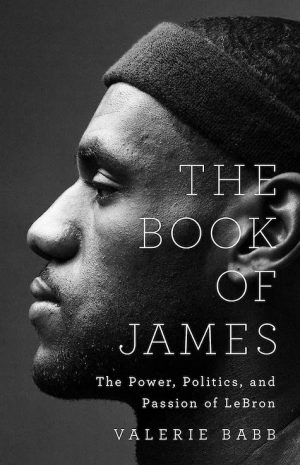
 An interesting examination of LeBron James in the context of wider American society, business and politics
The unique social, cultural, and political life of the incomparable LeBron James
LeBron James is the hero in two very American tales: one, a success story the nation loves; the other, the latest installment in an ongoing chronicle of American antiblackness. He’s the poor boy from a “broken” home who makes good. He’s also the poor Black boy from a “broken” home who makes good, then at the apex of his career finds “n*****” spray-painted across the gate to his home.
James has lived in the public eye ever since high school when his extraordinary athletic skills subjected his every action, every statement, every fashion choice to intense public scrutiny that tells us less about James himself and more about a nation still wrestling with many social inequities. He uses his celebrity not to transcend Blackness, but to give it a place of cultural prominence, and the backlash he receives exposes the frictions between Blackness and a country not fully comfortable with its presence. As a result, James’s story is a revelatory narrative of how much Blackness is loved, hated, misunderstood, and just plain cool in an America that has changed and yet not changed at all.
I thought Valerie Babb’s new book would offer an interesting and different take on LeBron James’s career and impact — on sports, culture, business, and politics. Babb certainly delivered this, and the book contains plenty of interesting and thought-provoking content. However, James himself seemed strangely secondary for much of it. Nevertheless, it’s an interesting read.
When I saw this book was on the way, I automatically put it on my Must Read list — I’ve been slowly reading NBA-related titles for the past few years, expanding my understanding of the sport, its history, and its cultural and political impact. (In part because I’m just a fan of the NBA and basketball, and partly for my own research reasons.) “What else is there to write about LeBron?” someone asked me. Which is a pretty valid question: not only is Babb’s book out this year, but Jeff Benedict’s LeBron was released back in April — and these two books join a growing shelf of James-related titles, including Brian Windhorst’s The Return of the King (very good) and LeBron, Inc. (fine).
When we view James as cultural subject and not just athlete, unresolved tensions between Blackness and antiblackness become apparent. Rather than using celebrity to transcend Blackness, he uses it to give Blackness a place of prominence in American narrative-making, leaving a cultural record of how much Blackness is loved, hated, misunderstood, and just plain cool in an America that has changed and yet not changed.
Babb does a very good job of locating James and his career in the wider context of African American opportunity (or lack thereof) and how unusual his success actually is, but also how it has transcended his sporting talent into other areas that many might have believed impossible when he first entered the league. The author also does a very good job of showing how, despite James’s incredible success and celebrity, he is not immune from the darker aspects of American culture and society (for example, the continued racist attacks on and criticisms of him and his work).
LeBron James built a business empire on basketball and Black culture that most underestimated because the minds behind that empire were young, Black, male, and hardly privileged. Worse yet, those minds succeeded wildly. Worse still, business success gave James the influence to interject his opinions into spaces some thought they weren’t cleared to enter.
At times, though, it felt as if LeBron James was incidental to what Babb wanted to write about. There were many passages or chapters that I finished only with the impression that “LeBron was there, too”. A strange takeaway from a book called The Book of James… Babb’s examination and discussion of American society, politics and culture is excellent throughout. It was just strange that James wasn’t always really necessary for that discussion. The author takes readers through a full range of social and political topics, clearly explained and well presented.
In addition to not really centring James as much as one might expect from a book bearing his name and likeness on the cover, Babb also falls into the trap of portraying her subject as pretty much infallible. One of course expects a biography to be sympathetic to the subject, however all of his decisions and actions are presented as genius, and there is very little evidence of any stumbles, missteps, or mistakes. I doubt very much that even LeBron would consider himself infallible and every one of his decisions to have been perfect or resulted in success. This weakened the impact of the book. It would have been far more interesting, not to mention more honest, if Babb had examined the journey of the “Four Horsemen” (James and his long-time friends and collaborators) from young star-and-entourage to business powerhouses. This wouldn’t have taken away from their incredible achievements — Babb could still have examined the barriers that are in front of all minorities in America, whether educational, social, economic, or political. Additionally, evidence of pivots would have strengthened the portrait of LeBron’s skills and acumen. In other words, the book could have benefited from a bit more nuance in its portrait of LeBron et al.
I only noticed one instance when the author came close to criticizing James’s words or actions: in relation to his Cleveland Cavaliers teammate Ira Newble’s open letter protesting the NBA’s increasingly-close ties to China in the run-up to the 2008 Olympics in Beijing, attempting to draw attention to China’s role in the Sudan conflict. James was one of only three Cavs who didn’t sign on to the letter, saying he wasn’t educated about the issue, despite Newble producing reading materials and disseminating it amongst his teammates. (James later acknowledged that he’d been too young to really appreciate what would have been the best response on his part.)
In conclusion, The Book of James is an interesting, albeit somehow incomplete book. It just about manages to be a biography of LeBron James, but it is certainly a good account of ongoing social and political issues in America in the 21st Century. I’d say this is probably more for those interested in politics and culture, rather than a biography for NBA fans. (Even though Babb does a very good job of addressing the idea that they are not mutually exclusive, nor should it be strange that those interested in politics can also be as interested in sports.)
*
Valerie Babb’s The Book of James is due to be published by PublicAffairs in North America and in the UK, on November 28th.
Follow the Author: Website, Goodreads
Review copy received via Edelweiss
 Civilian Reader