 A terrible truth revealed and the hunt to suppress it
The galaxy is burning. The Emperor’s loyal primarchs prepare to do battle with Warmaster Horus and his turncoat Legions on the black sand of Isstvan. Such dark times herald new and yet more terrible things still to come, and when Astropath Kai Zulane unwittingly learns a secret that threatens to tip the balance of the war, he is forced to flee for his life. Alongside a mysterious band of renegades, he plunges into the deadly underworld of Terra itself, hunted like a criminal by those he once trusted. In the face of betrayal, Kai must decide where his own loyalties lie and whether some truths should be buried forever.
The Outcast Dead is the latest novel in Black Library’s New York Times bestselling Horus Heresy series. It’s a slightly different kind of novel to previous Heresy novels (including McNeill’s own contributions to the series), and offers an alternative perspective of the brewing civil war, away from the front lines. It’s a refreshing take on the period, and one that adds greater depth to our understanding of how the Imperium reacted on its home turf to the rebellion.
The novel does not actually address the events laid out in the synopsis for quite some time – which really only kick in around page 180. At first, we spend time with the inhabitants of the City of Sight (the home of the Astronomican), and also some denizens of the Petitioners’ City – a shanty town that has grown around the vast Imperial Palace, populated by petitioners and pilgrims. It’s an interesting glimpse into the lives of the ‘normal’ humans of Terra, and also a fascinating look into the telepathic operations of the Imperium.
This is also when we are introduced to some of the key human characters of the novel: Kai, the astropath recovering from a catastrophic event that brought his last assignment to a bloody and horrific end, who over the course of his rehabilitation receives a potentially destabilising vision of the future (won’t say how – as mentioned above, it takes a while to happen, and it’s one of the most interesting sequences in the novel). Those assigned to Kai’s rehabilitation (and eventual interrogation) become key players in the tragic hunt for the truth that forms the bulk of the novel. We also meet Roxanne, linked to Kai through their last assignment yet separated by circumstances and on account of her being a Navigator (a rare, highly-prized and -protected caste of psychic mutants, the only ones able to safely steer spacecraft through the warp), who has run away from her past to settle with the quite broken pilgrims at the Temple of Woe.
I can see people getting annoyed at the fact that the synopsis printed on the back cover details events that start happening relatively late in the novel – in a similar way that many readers were a little frustrated that Prospero Burns spent very little time on the Space Wolves’ attack on Prospero and the planet’s subsequent destruction. For me, it took a few pages to accept this was going to be the case, but it didn’t trouble me much at all. I actually like the fact that the authors working on the Horus Heresy series are taking their time to build a fuller picture of the Imperium and the Astartes Legions of this time – in many cases, they are offering alternative perspectives of certain ‘truths’ that have been part of the Warhammer 40,000 canon for decades, adding layers of nuance that have been lacking, and thereby making the history of the Imperium and Traitor Legions so much more interesting and fascinating.
Some connections are drawn to McNeill’s previous Heresy novel, A Thousand Sons – not only is one of the traitor Astartes who makes up the Outcast Dead of the title a member of the Thousand Sons legion, but we also get to see some of the wider implications and repercussions of Primarch Magnus’s ill-advised and ill-received warning to the Emperor of the truth behind the Isstvan betrayal. The massive amounts of psychic energy released by Magnus’s plan (transporting his ethereal essence across space from his semi-exile on Prospero) has a huge, deadly impact on the City of Sight and its inhabitants. I particularly liked that McNeill took us into this, as it was something that hadn’t occurred to me at all when I read of it in other novels and (years before that) a couple of background books. This sequence was very well constructed and written, I thought.
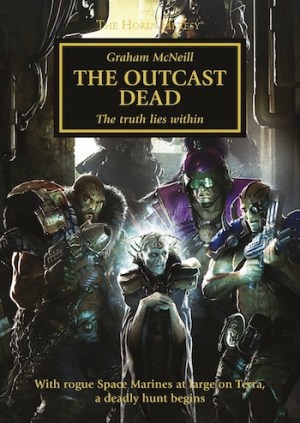
So, who are the “Outcast Dead” of the title? They are a group of Astartes from the newly-traitor Legions, apprehended when sent to Terra as part of an Honour Parade celebrating the successes of the Crusade – three World Eaters, and one each of the Emperor’s Children, Death Guard, Luna Wolves and Thousand Sons Legions. When we finally spend some time with them, McNeill gives us a look at another side of their characters. Separated from their Legions and Primarchs for decades, they question their loyalties – they are drawn from only the Legions to have openly declared their allegiance to Horus’s rebellion, or the persecuted Thousand Sons (the latter taking the form of Atharva, the mastermind of their jail-break and also a superb character).
One of McNeill’s greatest strengths (one shared by Dan Abnett and Aaron Dembski-Bowden) is his ability to make us question what has become common-knowledge and conventional wisdom of the Legions who turned traitor, as well as the Astartes as a whole.
“They were created to be the ultimate warriors, and it is easy to assume they are nothing more than gene-bred slayers whose only purpose is to kill and destroy. But they are far more than that. Their minds have been enhanced beyond mortal comprehension…”
The warriors must question who their loyalties belong to – their Primarchs and Legions, or the Emperor and Imperium of Mankind? As mentioned, they have been separated from their brothers, persecuted by the very people and leadership they have been fighting for. The author manages to deal with these issues quite deftly, never coming across as cliché or flat.
McNeill has created some great characters – particularly in the Astartes, who are likeable and noble, while also repellent in their brutality (yes, mainly the World Eaters). They have a different world-view than the humans they are forced to interact with, and the stark differences between human and post-human is fascinating and well realised on the page. A strange, new bond of brotherhood forms between the members of the Outcast Dead, and is quickly established. We get a very good sense of the growing connection between these disparate Astartes, thrown together through no fault of their own.
The Outcast Dead is a very atmospheric novel, which should not be surprising, given the subject matter and the focus on the psychic castes of the Imperium. It’s a slower Heresy novel than some of the others, but one that is very well constructed and plotted, and engages pretty much from the get-go. The Outcast Dead does what every other novel (especially the most recent ones) has done: it adds more layers of grey to the growing history of this time; things are not as black-and-white or clear-cut as we have been led to believe – at least, not with regards to a considerable number of players in the greater game – some actually are just as ill-intentioned as we expected, but many truly believe in the virtue of their causes, but just happen to be on the (eventual) losing side.
There are more elements of the suspense and perhaps even horror genres at work in this novel, as the psychic arenas we spend some time in are pretty weird. It’s also a novel of emotions far more than warfare. That being said, there is a particularly brutal final confrontation, which offers some of the most graphic duels of the series. We also see some key events through Kai’s psychic sight, which adds another interesting and original dimension and perspective on the characters of the Astartes, Custodes and other protagonists and antagonists.
McNeill’s writing style is very fluid, although also quite descriptive. This works for the most part, but there are a few moments when it’s a little more florid than necessary. These passages certainly don’t ruin the novel by any means, but there were definitely times when I just wanted to draw a red line through some of the adverbs. Typos were far more prevalent than previous novels, too (the occasional missing “the” or “as”, for example, and some erroneous swaps – “form” instead of “from”, “by” instead of “be”, the wrong “it”, “its” or “it’s” – and a number of others). This was a bit disappointing, as Black Library has managed to crack down on these sorts of errors exceptionally well over the last five years, making their novels some of the cleanest and error-free on the market. It’s not rampant, but when it occurs in important, repeated phrases, it can be quite jarring.
The Horus Heresy series is an exceptional achievement, and The Outcast Dead builds on what has already taken place, pushing the narrative forward, while also taking the story into new and unexplored territory. It won’t be loved by everyone – certainly not readers who just want endless action and warfare – but it is an engaging and thoughtful novel; one that looks to the peripheries of the action and offers a grounds-eye view of the unfolding Heresy, and focuses at the same time on the meaning of loyalty and betrayal in their various guises, at a time of great uncertainty.
The novel (and series as a whole) is an interesting philosophical discussion of warfare, history and more. In particular, The Outcast Dead examines the Imperium’s tyrannical enforcement of norms: the unflinching belief in a cause, intolerant of anything that calls these norms or the methods used to maintain them into question. It is through this lens that the greater tragedy of the Heresy is revealed.
As with all of the Horus Heresy novels since (and including) A Thousand Sons, The Outcast Deadis thought-provoking and, in addition to some pretty brutal action scenes, offers a surprising depth. The series is a truly epic tragedy, and it is thrilling to be along for the ride, witnessing it unfold from such myriad perspectives.
Very highly recommended.
 Civilian Reader